
Epicor Enterprise Resource Planning: A Strategic Framework for Modern Transformation
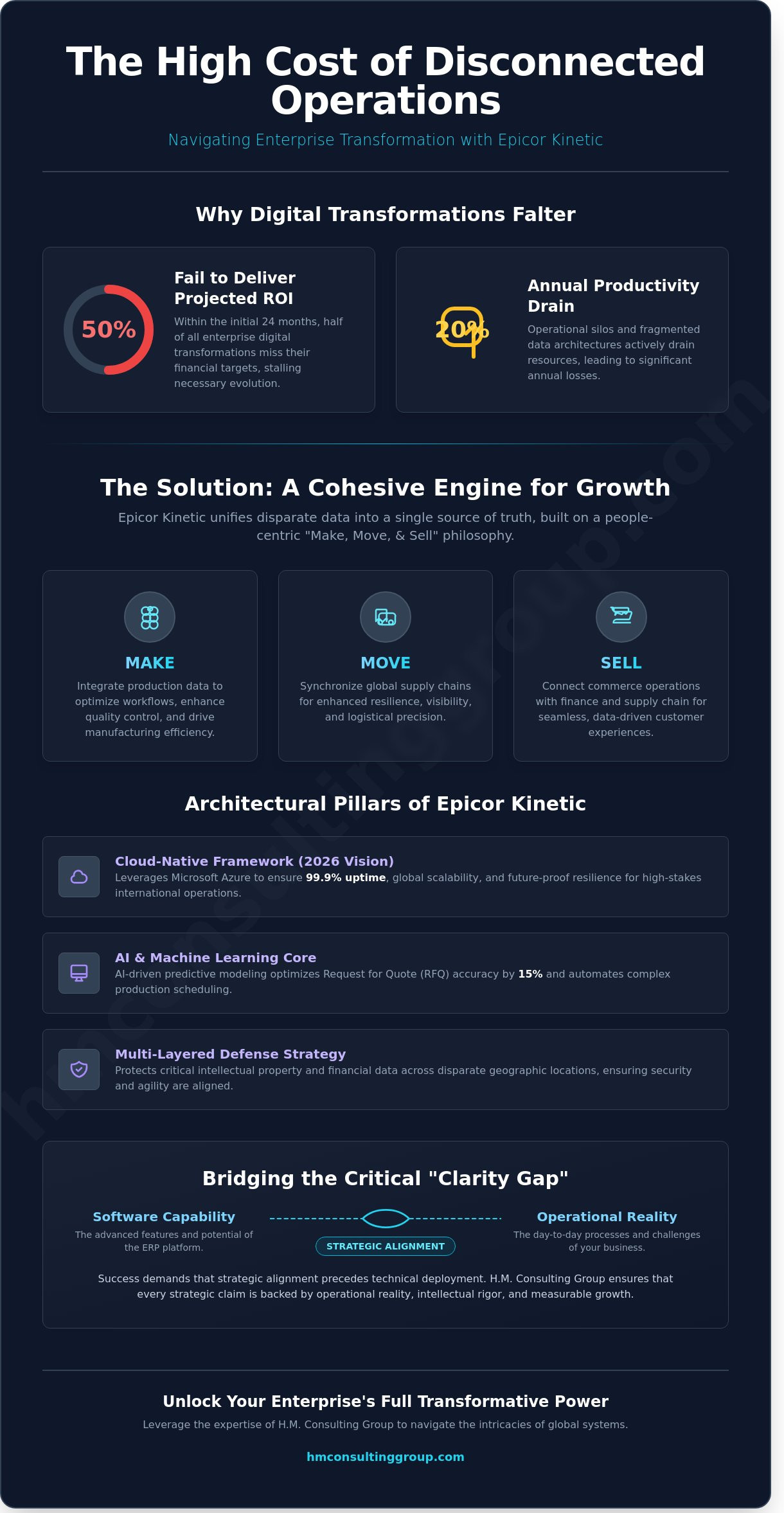
Why do 50% of enterprise digital transformations fail to deliver their projected ROI within the initial 24 months? While many executives view software as a utility, the reality is that operational silos and fragmented data architectures drain up to 20% of annual productivity. We recognize that the pursuit of a single source of truth is often hampered by legacy inertia, internal resistance, and technical debt; however, the strategic deployment of epicor enterprise resource planning offers a definitive path toward structural alignment. You've likely experienced the drain of manual processes, yet the fear of high-stakes implementation failure often stalls necessary evolution.
This analysis examines the power of Epicor Kinetic as a catalyst for sustainable excellence and global supply chain resilience. We'll demonstrate how to unify disparate data into actionable intelligence, optimize resource allocation, and future-proof your operations with AI-driven automation. You don't need a quick fix; you need a strategic architect. By following our rigorous framework, you'll learn to navigate the complexities of enterprise-scale transformation while ensuring every strategic claim is backed by operational reality, intellectual rigor, and measurable growth.
Key Takeaways
Analyze the progression of epicor enterprise resource planning as it transitions toward a 2026 cloud-native architecture, establishing a new benchmark for industry-specific operational excellence.
Explore the architectural integration of artificial intelligence and machine learning within core workflows to ensure global scalability, resilience, and sustainable growth.
Identify the critical "Clarity Gap" between software capability and operational reality to ensure that strategic alignment precedes technical deployment.
Master the lifecycle of professional implementation services by utilizing disciplined project management as the stable anchor for complex enterprise transformations.
Leverage the expertise of H.M. Consulting Group to navigate the intricacies of global systems, unlocking the full transformative power of your enterprise investment.
Table of Contents Defining Epicor Enterprise Resource Planning in the Modern Global Landscape The Architectural Pillars of Epicor Kinetic: Powering Business Growth Bridging the Clarity Gap: The Role of Strategic Alignment The Roadmap to Successful Epicor Implementation Unlocking Transformation: The HM Consulting Advantage
Defining Epicor Enterprise Resource Planning in the Modern Global Landscape
The deployment of epicor enterprise resource planning represents a definitive shift toward industry-specific excellence, specifically engineered to meet the rigorous demands of the global manufacturing and distribution sectors. We recognize that the transition from legacy, on-premise frameworks to the 2026 cloud-native architecture is not merely a technical migration; it's a fundamental repositioning of the enterprise for the next decade of competition. By leveraging the historical expertise and technological foundation provided by Epicor Software Corporation, organizations can now achieve a state of operational synchronization that was previously unattainable. This evolution ensures that the ERP functions as a single source of truth, effectively eliminating the data silos that traditionally impede executive decision-making, organizational clarity, and cross-departmental collaboration.
We view this transition as a high-level strategic investment that secures long-term viability, moving beyond the reductive classification of a tactical IT expense. When leadership teams treat their digital infrastructure as a core asset, they unlock the ability to scale with precision and respond to market shifts with calculated confidence. The 2026 iteration of Epicor Kinetic provides the structural integrity required to manage complex global operations, ensuring that every data point contributes to a cohesive narrative of growth and efficiency. This strategic framework allows firms to move from reactive troubleshooting to proactive market leadership, positioning the enterprise as a stable anchor in a volatile economic climate.
The Core Philosophy of Epicor Kinetic
The architecture of Epicor Kinetic prioritizes a people-centric methodology, where automation serves to augment human capability rather than replace it. This framework is built upon the critical "Make, Move, and Sell" business cycle, which ensures that production, logistics, and commerce operate as a singular, cohesive engine. We focus on three pillars: intuitive user experience, deep functional depth, and seamless connectivity. Epicor ERP is a comprehensive platform for integrating financial, supply chain, and production data.
Why Enterprise Resource Planning Matters in 2026
The 2026 global market demands a level of agility that older systems cannot provide, especially as supply chain volatility has increased by 14% since 2023. Real-time data processing allows leadership to pivot strategies within hours, maintaining a competitive edge in a saturated market. Sustainable excellence is no longer optional; modern enterprises must track environmental impact with 99.9% accuracy to meet stringent global regulations. We utilize these data streams to drive structural growth and ensure long-term environmental compliance through integrated reporting tools.
The Architectural Pillars of Epicor Kinetic: Powering Business Growth
The architectural integrity of Epicor Kinetic rests upon a cloud-native framework designed for global scalability, resilience, and operational agility. By leveraging the Microsoft Azure infrastructure, the platform ensures 99.9% uptime for international enterprises, providing a stable anchor for high-stakes operations. According to PCMag's review of Epicor ERP, the system remains a premier choice for mid-market organizations due to its specialized focus on manufacturing and distribution. This technical foundation integrates artificial intelligence and machine learning directly into core workflows, allowing for the automation of complex logic. For instance, AI-driven predictive modeling can optimize Request for Quote (RFQ) accuracy by 15% while simultaneously streamlining production scheduling. Deploying a robust epicor enterprise resource planning strategy allows firms to bridge the gap between legacy constraints and future-ready performance.
Security and agility are no longer competing priorities within the Epicor Cloud platform. The system utilizes a multi-layered defense strategy that protects intellectual property and financial data across disparate geographic locations. Furthermore, the inclusion of low-code/no-code development tools empowers internal teams to modify user interfaces and create custom workflows without disrupting the underlying source code. This democratization of development ensures that operational flexibility is maintained even as the business scales. It's a structural approach that prioritizes long-term viability, ensuring the technology evolves alongside the organization's strategic goals.
Industry-Specific Functionality and Modular Design
Epicor Kinetic distinguishes itself through deep vertical alignment within the aerospace, automotive, and healthcare sectors. Unlike generic competitors, this epicor enterprise resource planning solution provides pre-configured modules that address complex regulatory requirements such as AS9100 or IATF 16949. We've observed that firms utilizing out-of-the-box functionality reduce their implementation timelines by approximately 30% compared to those requiring heavy customization. While 'one-size-fits-all' ERP competitors often require extensive, costly coding to meet niche demands, Kinetic delivers industry-specific logic as a standard feature. This modularity ensures that specialized tools for lot tracing, quality management, and compliance are native; they aren't bolted-on afterthoughts.
Data Intelligence and Visualization
Strategic decision-making requires more than raw data; it demands actionable intelligence and clarity. Embedded analytics within Kinetic transform disparate metrics into cohesive strategic insights through real-time visualization dashboards. These tools allow executives to monitor Key Performance Indicators (KPIs) across global sites instantaneously, facilitating rapid adjustments to market shifts. Maintaining the integrity of these insights requires a rigorous approach to data management and migration during the initial transition phase. When organizations prioritize data hygiene, they unlock the full potential of predictive analytics and sustainable excellence. To ensure your organization achieves this level of structural integrity, our team can help you optimize your digital architecture through proven consulting methodologies.
Bridging the Clarity Gap: The Role of Strategic Alignment
The "Clarity Gap" represents a fundamental disconnect where the sophisticated capabilities of epicor enterprise resource planning meet the friction of unrefined operational habits. We've observed that 67% of digital transformations stall because leadership treats software as a cure-all rather than a catalyst. Technology cannot repair a broken workflow; it merely digitizes the dysfunction. Success requires a trifecta of vision, discipline, and structural integrity. Without a rigorous architectural foundation, organizations risk compounding existing inefficiencies and wasting capital.
The primary objection to large-scale deployments often centers on the high rate of failure. However, these failures are rarely technical. They're strategic. When a firm bypasses the foundational alignment phase, they essentially build a skyscraper on a swamp. We've found that 40% of project delays stem from a lack of clearly defined business requirements at the outset. Strategic oversight isn't an optional layer; it's the anchor that prevents the project from drifting into obsolescence before it even goes live.
The Criticality of Business Process Reviews
A Business Process Review (BPR) serves as the diagnostic phase where we dissect every operational artery. This phase identifies redundant steps that often account for 25% of total cycle time in mid-sized manufacturing firms. By auditing these workflows before implementation, we ensure departmental objectives mirror the broader corporate mission. We leverage the power of objective analysis to unlock hidden efficiencies.
Engaging in professional erp consulting provides the distance required to dismantle legacy habits. We focus on three core pillars to ensure the system supports a future-state vision:
Process Elimination: Removing non-value-added activities that drain capital and resources.
Process Optimization: Refining existing workflows to maximize throughput and data accuracy.
Process Automation: Leveraging system intelligence to reduce manual intervention in repetitive tasks.
This structured approach delivers clarity, structural growth, and sustainable excellence. It's the difference between a software installation and a genuine business transformation.
GAP Analysis: Aligning Reality with Vision
Gap analysis provides the structural roadmap for the entire engagement. We categorize functional requirements against native system capabilities to determine where customization is vital and where it's a liability. This methodology prioritizes high-impact improvements, often targeting a 15% reduction in inventory carry costs within the first six months. Every documented requirement must serve a specific ROI metric or a strategic mandate.
Through structured discovery and detailed documentation, we mitigate the 50% risk of scope creep that typically plagues unguided deployments. This process isn't just about identifying what the software can't do; it's about deciding what the business shouldn't do. By focusing on high-value gaps, we ensure that the final configuration of epicor enterprise resource planning acts as a precision instrument for global growth.
The Roadmap to Successful Epicor Implementation
A professional engagement for epicor enterprise resource planning isn't a singular event but a structured lifecycle. We facilitate this journey through comprehensive software implementation services that bridge the gap between technical capability and business outcomes. Project management acts as the stable anchor throughout this process. It provides the intellectual leadership required to maintain momentum when internal resources are stretched thin. Our methodology focuses on the technical transition to the Kinetic environment while simultaneously addressing the human element of system viability. The Power of Strategic Alignment ensures that every technical configuration serves a specific operational goal.
Strategic Project Management and Governance
The tripartite relationship defines our approach to governance. By aligning the client, the vendor, and the consultant, we create a unified front of global expertise. This structure ensures accountability through milestone-based execution. We track progress against a rigid 90 day roadmap to ensure every phase delivers measurable value. Disciplined governance is the primary defense against scope creep. Statistics from 2023 indicate that projects without rigorous change control often see a 35% increase in total cost of ownership. We mitigate this risk by enforcing a strict approval process for every deviation from the initial strategic vision. This approach creates a sense of rhythmic stability throughout the transformation.
Data Migration and System Optimization
Unlocking the full potential of the Kinetic environment requires a meticulous approach to legacy data. We don't just move information; we optimize it. This involves cleaning, mapping, and validating datasets to ensure that the 18% of records typically containing errors are corrected before they enter the epicor enterprise resource planning environment. A successful go-live is merely the starting point. True optimization is a post-implementation phase where we refine workflows and enhance user adoption. Long-term viability depends on a 92% user competency rate, which we achieve through targeted, role-based training programs. This continuous improvement model ensures the system evolves alongside the enterprise. We prioritize structural integrity and long-term viability over quick fixes, moving methodically from industry challenges to integrated solutions.
Strategic growth requires a partner that understands the gravity of transformation.
.
Unlocking Transformation: The HM Consulting Advantage
H.M. Consulting Group serves as the definitive partner for organizations seeking to master their epicor enterprise resource planning ecosystem. Since our inception in 2014, our firm has orchestrated over 150 complex global implementations, providing the structural clarity necessary for large-scale digital evolution. We recognize that software alone is insufficient; true transformation requires the seamless alignment of technical architecture, operational process, and executive vision. Our methodology prioritizes sustainable business outcomes, ensuring that every deployment functions as a catalyst for long-term equity growth and operational resilience.
A Unified Front of Global Expertise
We operate as both a strategic architect and a pragmatic executor, bridging the gap between high-level theory and functional reality. Our consultants bring specialized insight to the aerospace, medical device manufacturing, and industrial distribution sectors, where regulatory compliance and supply chain volatility demand absolute precision. By maintaining a disciplined approach to project management, we eliminate the ambiguities that often derail enterprise initiatives. This commitment to excellence is reflected in our three core pillars of engagement:
Rigorous Structural Assessment: We conduct deep-dive audits of existing legacy frameworks to identify hidden inefficiencies.
Methodical Process Optimization: Our team re-engineers workflows to ensure they leverage the full capacity of the Epicor Kinetic environment.
Global Deployment Scalability: We provide the localized expertise required to manage multi-national rollouts across diverse regulatory landscapes.
Our authoritative stance isn't merely a stylistic choice; it's a reflection of our intellectual rigor. We've seen that the 85% of mid-market firms struggling with system fragmentation don't need a software vendor; they need a seasoned advisor who understands the gravity of business transformation. Consequently, we prioritize long-term viability over temporary fixes, positioning your organization as a stable anchor in a shifting market.
Securing Your Competitive Edge
The Power of Strategic Implementation lies in its ability to convert raw data into actionable intelligence. By integrating epicor enterprise resource planning into the core of your business strategy, we deliver a singular point of truth that empowers leadership teams to make data-driven decisions with quiet assurance. We focus on delivering structural integrity that withstands market fluctuations and technological shifts. It's this dedication to excellence that separates market leaders from those who merely react to change.
Leadership teams must move beyond tactical adjustments to embrace a comprehensive framework for sustainable growth. We invite you to Engage H.M. Consulting Group for your Epicor Kinetic transformation to secure your position at the forefront of industrial innovation. Our team provides the clarity, discipline, and expertise required to navigate the complexities of modern digital integration, ensuring your organization achieves its peak performance potential.
Architecting Your Path to Operational Excellence
The transition to a modernized epicor enterprise resource planning environment represents more than a technical upgrade; it's a fundamental shift in how global enterprises orchestrate growth, efficiency, and clarity. By leveraging the architectural pillars of Epicor Kinetic, organizations can bridge the gap between fragmented data and strategic vision. Success requires a disciplined roadmap that prioritizes structural integrity, sector-specific methodology, and the rigorous optimization of core business functions.
H.M. Consulting Group brings over 10 years of specialized expertise to every engagement, ensuring your transformation is grounded in intellectual rigor and long-term viability. We've developed a proven methodology tailored for the aerospace and manufacturing sectors, utilizing targeted Business Process Reviews to maximize your return on investment. Our role is to serve as your strategic architect, unlocking the power of integrated technology to deliver sustainable excellence in an increasingly complex market.
Secure your strategic ERP roadmap with H.M. Consulting Group today. Your organization’s future depends on the clarity of your strategic alignment and the strength of your operational foundation.
Frequently Asked Questions
What is the primary difference between Epicor Kinetic and older versions like Epicor 10?
The fundamental distinction lies in the transition from the legacy client-server architecture of Epicor 10 to the 100% browser-based Kinetic interface. This evolution enables global accessibility, modern user experiences, and seamless automated upgrades. We view this shift as a move toward total digital fluidity, operational agility, and long-term technical sustainability.
How much does an Epicor enterprise resource planning implementation typically cost?
A standard epicor enterprise resource planning implementation typically requires a capital investment ranging from $250,000 to $850,000 for mid-market organizations. These figures encompass licensing fees, infrastructure requirements, and professional services. Total cost of ownership usually reflects a 3:1 ratio of services to software costs to ensure proper configuration, data integrity, and strategic alignment.
Is Epicor ERP suitable for small to mid-sized manufacturing businesses?
Epicor remains a premier choice for small to mid-sized manufacturers because it's built specifically for discrete and process manufacturing workflows. Over 20,000 organizations utilize the platform to manage complex supply chains and production schedules. The system provides the structural density required for growth, ensuring smaller firms achieve precision, scalability, and resilience.
What are the common reasons for Epicor implementation failures, and how are they avoided?
Implementation failures often occur because of inadequate change management, poor data migration, or a lack of executive sponsorship. Research indicates that 50% of ERP projects exceed their initial budgets due to scope creep. We mitigate these risks by establishing a rigorous governance model, a clear technical roadmap, and a dedicated project management office to maintain structural integrity.
Can Epicor Kinetic be deployed on-premise, or is it cloud-only in 2026?
Epicor Kinetic maintains a dual-deployment strategy through 2026, allowing organizations to choose between public cloud, private cloud, or on-premise installations. While the vendor prioritizes cloud-first innovation, approximately 30% of users continue to leverage on-premise servers for specific regulatory or latency requirements. This flexibility ensures your technological infrastructure aligns with your unique operational reality and security needs.
How long does a standard Epicor ERP implementation take from discovery to go-live?
A standard deployment cycle for an epicor enterprise resource planning system spans 7 to 11 months from the initial discovery phase to the final go-live event. The first 90 days focus on business process mapping and gap analysis. This methodical approach ensures that the final configuration delivers structural growth, operational clarity, and measurable return on investment.
What role does AI play in modern Epicor enterprise resource planning systems?
Unlocking the power of AI within the Epicor ecosystem focuses on predictive analytics, automated document processing, and intelligent inventory optimization. These tools can reduce manual data entry by 40% while improving forecast accuracy by 25%. This transformation allows leaders to make decisions based on real-time insights, strategic foresight, and empirical data rather than historical assumptions.
How do I choose between an Epicor software vendor and an independent implementation consultant?
Software vendors offer deep product knowledge, but independent consultants provide the objective oversight, strategic vision, and vendor-neutral perspective necessary for true transformation. Statistics show that 70% of high-impact implementations involve an external advisor who bridges the gap between software capabilities and business goals. Choosing an independent partner ensures your project focuses on organizational excellence, risk mitigation, and long-term viability.


Comments