

Strategic Software Implementation Services: A Framework for Enterprise Transformation (2026)
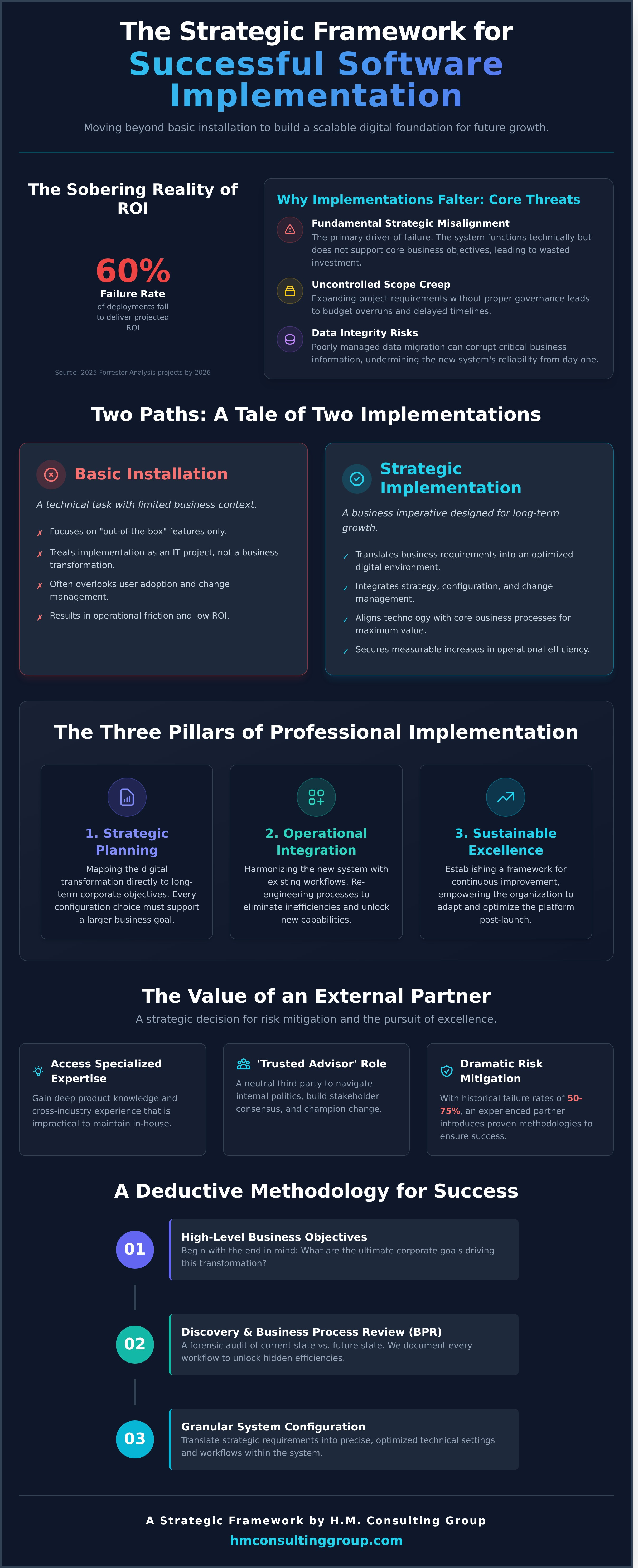
A 2025 Forrester analysis projects that by 2026, over 60% of enterprise software deployments will fail to deliver their projected return on investment, primarily due to fundamental strategic misalignment. This statistic is a stark validation of the anxieties many executives face. The fear of uncontrolled scope creep, the risk to data integrity during migration, and the challenge of overcoming internal resistance are not merely operational hurdles; they are significant threats to enterprise transformation.
This reality is precisely why a new paradigm for professional software implementation services is required. Our objective at H.M. Consulting Group is to provide a definitive framework that navigates these complexities, ensuring a seamless transition to leading enterprise platforms. Within this article, we will delineate a strategic methodology designed to secure a measurable increase in operational efficiency and establish a scalable digital foundation for the next decade of your organization's growth.
Key Takeaways
Differentiate between basic software installation and a strategic implementation framework designed for long-term enterprise growth.
Understand a proven, deductive methodology that moves from high-level business objectives to precise technical configurations for a seamless deployment.
Discover how to leverage GAP analysis as a strategic tool to align system capabilities with unique operational needs and mitigate integration risks.
Develop a clear set of criteria for evaluating software implementation services, ensuring you select a partner with the industry-specific experience required to maximize ROI.
Table of Contents Defining Software Implementation Services: Beyond Technical Deployment The Lifecycle of Strategic Implementation: A Proven Methodology for Success Data Migration and GAP Analysis: Navigating the Complexity of ERP Integration Mitigating Risk and Maximizing ROI: Selecting an Implementation Partner Unlocking Operational Excellence with HM Consulting Group
Defining Software Implementation Services: Beyond Technical Deployment
In the corporate lexicon, the concept of implementation is frequently misunderstood, often reduced to the mere technical act of installing software. This perspective is dangerously simplistic. A genuine enterprise transformation, particularly with sophisticated systems like Epicor Kinetic, demands a far more rigorous approach. An out-of-the-box installation is a technical task; a strategic implementation is a business imperative. The complex process of software implementation must be viewed as a holistic discipline that integrates high-level strategy, granular configuration, and organizational change management. We define software implementation services as the systematic translation of business requirements into a functional, optimized digital environment.
The Power of Alignment is a critical factor that separates success from failure. Technical success, measured by on-time deployment and budget adherence, does not guarantee business success. A system can function perfectly from a code perspective yet fail to deliver value if it isn't embraced by users or aligned with core business processes. According to a 2022 report by the Project Management Institute (PMI), 11.4% of all investment is wasted due to poor project performance. This misalignment is where most implementations falter, turning a promising investment into a source of operational friction and unrealized ROI.
The Three Pillars of Professional Implementation
Our methodology is built upon a tripartite framework designed to ensure that technological deployment translates directly into strategic corporate value. This structure provides the stability and foresight necessary for a successful digital evolution.
Strategic Planning: This initial phase moves beyond technical specifications to map the digital transformation directly to long-term corporate objectives, ensuring every configuration choice supports a larger business goal.
Operational Integration: We focus on harmonizing the new ERP system with existing departmental workflows, re-engineering processes where necessary to eliminate inefficiencies and unlock new capabilities without disrupting operational continuity.
Sustainable Excellence: The objective is not merely a successful go-live event but the establishment of a framework for continuous improvement, empowering the organization to adapt and optimize the platform long after the initial project concludes.
Why Organizations Invest in External Implementation Partners
Engaging a specialized consultancy is a strategic decision rooted in risk mitigation and the pursuit of excellence. Internal IT teams, while competent in maintaining existing systems, rarely possess the niche, project-based expertise required for a large-scale ERP migration. An external partner provides this focused capability and fulfills several critical functions.
Accessing Specialized Expertise: Partners bring deep product knowledge and cross-industry experience that is prohibitively expensive and impractical for an organization to maintain in-house.
The Role of the 'Trusted Advisor': A neutral third party is uniquely positioned to navigate internal corporate politics, build consensus among stakeholders, and champion the project through inevitable resistance to change.
Risk Mitigation: With ERP project failure rates historically cited between 50% and 75% by industry analysis firms like Panorama Consulting Group, an experienced partner introduces proven methodologies that dramatically improve the probability of a successful, on-budget outcome.
The Lifecycle of Strategic Implementation: A Proven Methodology for Success
A successful ERP transformation isn't a single event; it's a meticulously managed journey that typically spans 6 to 12 months. Our approach to these complex projects is fundamentally deductive, beginning with your highest-level strategic objectives and systematically translating them into granular system configurations. This structured lifecycle ensures that every technical decision is anchored to a defined business outcome. Throughout this entire process, a dedicated Project Manager serves as the stable anchor, providing consistent leadership, ensuring milestone accountability, and managing the critical path to deliver clarity, control, and sustainable growth.
Phase 1: Discovery and Business Process Review (BPR)
The foundation of any successful project is built during the initial Discovery and Business Process Review. This isn't a cursory overview; it's a comprehensive forensic audit of your current operational state versus your desired future state. We unlock hidden efficiencies by rigorously documenting every workflow, from quote-to-cash to procure-to-pay. Our analysis consistently reveals that organizations can eliminate 15-20% of redundant process steps through this review alone. The resulting BPR document becomes the definitive architectural blueprint, dictating every subsequent technical decision and ensuring perfect strategic alignment from day one.
Phase 2: System Configuration and Pilot Testing
With the strategic blueprint established, our technical consultants translate the BPR findings into the specific settings and workflows within your Epicor Kinetic environment. This phase is highly iterative, centered around a series of Conference Room Pilots (CRPs). In these sessions, your key users test core business scenarios in a sandbox environment, allowing for real-time feedback and system refinement. This validation loop is a critical component of any well-structured project, a principle detailed in every authoritative ERP implementation guide. The final gate is User Acceptance Testing (UAT), where we ensure the configured system fully empowers your frontline workforce to execute their roles with greater efficiency and accuracy.
Phase 3: Go-Live Execution and Hypercare
The Go-Live event marks the formal transition from legacy systems to the new, unified production environment. This is a critical inflection point where our professional software implementation services truly demonstrate their value. To mitigate operational friction, we immediately initiate a period of intensive ‘Hypercare’ support, providing dedicated on-site and remote expertise for the first 14 to 30 days post-launch. This ensures immediate issue resolution and reinforces user confidence. Simultaneously, we establish the foundational baseline for data visualization and reporting, transforming raw data into the actionable intelligence that drives future performance.
This disciplined, three-phase lifecycle is the mechanism that converts a powerful software tool into a genuine competitive advantage. It’s a proven methodology that mitigates risk, maximizes ROI, and is the core of how we architect sustainable excellence for our global partners.
Data Migration and GAP Analysis: Navigating the Complexity of ERP Integration
The true challenge of digital transformation lies not in acquiring new technology, but in the meticulous integration of historical data and established business processes. An ERP implementation's success is fundamentally determined by two critical, interconnected disciplines: data migration and GAP analysis. A 2021 report from Panorama Consulting Group revealed that over 55% of ERP projects exceed their initial budgets, a variance often directly attributable to unforeseen complexities in these two areas. An experienced consultant transforms these potential liabilities into strategic assets, ensuring the new system reflects both operational history and future ambition.
The Strategic Framework for Data Migration
The principle of 'garbage in, garbage out' is the single greatest threat to ERP ROI. Decades of legacy data are rarely clean; according to industry analysis, up to 30% of a typical organization's data can be redundant, obsolete, or trivial. Our approach to Epicor Data Migration and Management begins with a rigorous cleansing and normalization protocol. This foundational step involves mapping archaic data structures to Epicor Kinetic’s modern relational database, a complex translation process that requires deep architectural expertise. To guarantee integrity, we deploy a tripartite validation framework:
Financial Reconciliation: We ensure that trial balances, accounts receivable, and accounts payable ledgers match to the penny between the legacy system and the new ERP environment before go-live.
Operational Continuity: Critical operational data, including open sales orders, inventory levels, and multi-level bills of material (BOMs), are validated to prevent any disruption to production or fulfillment.
User Acceptance Testing (UAT): We facilitate structured testing cycles where your team validates the migrated data within real-world business scenarios, confirming its accuracy, accessibility, and utility.
Unlocking Value through GAP Analysis
A GAP analysis is not merely an audit of missing features; it is a strategic exercise to align a standardized platform with the unique processes that deliver your competitive advantage. It systematically identifies functional discrepancies between out-of-the-box software capabilities and specialized business requirements. This analysis provides the executive team with a clear decision matrix for every identified gap: Build, Buy, or Adapt. This crucial decision point is a core component of effective software implementation strategies, dictating the project's long-term total cost of ownership.
The objective is to achieve 'Smart Customization'-making targeted enhancements that drive significant value-while avoiding 'Over-Engineering,' which creates a brittle, difficult-to-maintain system. By confronting these decisions early in the project lifecycle, a consultant prevents the costly scope creep that, according to the Project Management Institute, contributes to over 37% of project failures. This foresight is a hallmark of professional software implementation services, transforming potential roadblocks into a clear roadmap for sustainable growth and operational excellence.
Mitigating Risk and Maximizing ROI: Selecting an Implementation Partner
The selection of an ERP partner is a definitive strategic decision, one that dictates the trajectory of your operational transformation for the next decade. In the competitive Northeast US market, saturated with providers, a superficial evaluation process is a direct path to project failure. A successful deployment hinges on identifying a partner whose value extends beyond technical execution to encompass strategic guidance, industry fluency, and a demonstrable commitment to your long-term growth. Evaluating potential software implementation services requires a granular, data-driven approach that scrutinizes not only what a firm can do, but how it delivers results.
Industry-specific experience is non-negotiable. A generic implementation cannot address the nuanced regulatory and operational demands of specialized sectors. For an Aerospace and Defense manufacturer, this means a partner who understands AS9100 compliance and intricate lot traceability requirements from day one. In Healthcare, it demands deep knowledge of HIPAA security protocols and the complexities of managing a GPO-driven supply chain. For complex Manufacturing, it requires expertise in optimizing shop floor data collection and integrating lean principles directly into the ERP framework. This specialized knowledge prevents costly customizations and ensures the system is configured for compliance and competitive advantage, not just basic functionality.
True partnership transcends the transactional nature of a simple project delivery. It's the difference between a vendor who completes a checklist and a consultant who stays engaged to drive continuous improvement. We believe in a model of sustained partnership, where go-live is merely the first major milestone in a longer journey of optimization. This commitment is evidenced by structured post-launch support, quarterly strategic reviews, and a roadmap for future phases. Furthermore, for organizations with headquarters or critical operations in the Philadelphia to New York corridor, a local presence is invaluable. High-stakes activities like discovery workshops and user acceptance testing demand the focused, collaborative energy that only on-site engagement can provide, mitigating the risk of miscommunication that plagues remote-only projects.
The Essential Consultant Selection Checklist
Your due diligence process must be rigorous and methodical. We recommend focusing on three core pillars that separate elite consultants from standard vendors:
Proven Epicor Kinetic Expertise: General ERP experience is insufficient. A prospective partner must present case studies of successful Epicor Kinetic implementations, ideally within your specific industry, demonstrating mastery of its cloud architecture and modules like Advanced MES or Financial Management.
Methodology Transparency: A premier firm operates with a documented, repeatable implementation methodology. Our own Strategic Alignment Framework ensures every phase, from discovery to deployment, is governed by clear milestones, risk mitigation plans, and transparent stakeholder communication.
Constructive Cultural Fit: The right partner won’t simply follow orders; they will challenge your assumptions to drive genuine business process re-engineering. You need an advisor with the confidence to question legacy workflows and guide your team toward a more efficient, scalable future state.
Measuring Implementation ROI
The business case for a new ERP is built on quantifiable returns. Our software implementation services are designed to deliver measurable value across short-term and long-term horizons. Within the first six months, our clients typically achieve a 45% reduction in manual data entry and a 60% decrease in order processing errors. Long-term gains are even more substantial, with organizations realizing an average 15% improvement in inventory turnover and compressing their financial close cycle from over 10 days to just 3. The alternative, the "Cost of Inaction," is equally quantifiable. A 2023 Nucleus Research report found that businesses running on legacy systems forfeit up to 3% of annual revenue to operational inefficiencies and excessive maintenance costs. The investment in a modern ERP isn't a cost; it's a strategic reallocation of capital away from sustaining inefficiency and toward enabling growth.
To understand how our disciplined methodology can de-risk your Epicor Kinetic project and deliver a clear return on investment, schedule a strategic assessment with our implementation experts.
Unlocking Operational Excellence with H.M. Consulting Group
Choosing the right ERP consultant is not merely a procurement decision; it is the appointment of a strategic architect for your company’s future. At H.M. Consulting Group, we embrace this responsibility, serving as the premier partner for organizations seeking to harness the full transformative power of Epicor Kinetic. Since our founding in 2013, we have guided over 75 firms in the Mid-Atlantic region and across North America through complex digital transformations, establishing a track record of precision and sustainable growth.
Our methodology is anchored in a foundational belief: The Power of Process. A successful ERP implementation is not about installing software; it’s about re-engineering the operational DNA of your business for peak performance. Our initial Business Process Review (BPR) is the critical first step, creating a comprehensive blueprint that aligns technological capabilities with your core strategic objectives. This ensures that your investment yields not just a new system, but a durable competitive advantage.
The H.M. Consulting Advantage
Our value proposition is built upon three strategic pillars designed to ensure comprehensive value realization from your Epicor Kinetic investment. We provide more than just technical deployment; we deliver a holistic framework for enterprise evolution.
Unrivaled Epicor Kinetic Mastery: Our dedicated focus on the Epicor Kinetic platform provides our clients with an unparalleled depth of expertise. We possess an intricate understanding of its technical architecture and functional capabilities, allowing us to configure the system to resolve your most specific industry challenges, from supply chain optimization to financial consolidation.
A Tripartite Service Model: We integrate our services into a complete support structure. Our engagement encompasses Strategic Advisory to align the project with executive vision, Technical Execution for flawless implementation, and continuous Managed Support to drive post-launch optimization and user adoption.
A Collaborative Partnership: We believe that sustainable success is achieved when your internal team is empowered. Our model emphasizes intensive knowledge transfer, equipping your employees with the skills and confidence to own and operate the new system effectively, thereby reducing long-term dependency and maximizing your return on investment.
Your Path to Digital Transformation
Our engagement follows a deliberate, three-phase methodology engineered for clarity, precision, and predictable outcomes. We move methodically from high-level strategy to granular execution.
The journey begins with an Initial Strategic Consultation, where we work with your leadership to define project scope and crystallize key business objectives. This ensures complete alignment from day one. Following this, our team conducts a Comprehensive Business Process Review and GAP Analysis. This deep-dive diagnostic is where our software implementation services truly differentiate; our BPRs typically uncover potential for a 15-20% improvement in operational throughput by identifying and eliminating systemic inefficiencies before a single line of code is configured.
Finally, we proceed to Seamless Execution and Post-Implementation Optimization. Our expert team manages the technical deployment with meticulous project management, ensuring minimal disruption and a successful go-live. Our partnership, however, extends far beyond this milestone, as we provide ongoing support to refine processes and ensure your organization extracts maximum value from its new digital core.
The time for operational transformation is now. Contact H.M. Consulting Group to begin your strategic software implementation journey.
Unlocking Sustainable Growth Through Strategic Implementation
The path to enterprise transformation, as detailed for 2026, extends far beyond technical deployment. It demands a strategic framework that rigorously navigates complex data migration and a disciplined methodology that ensures total organizational alignment. Selecting the right partner for your software implementation services isn't merely a vendor choice; it's the single most critical decision in mitigating risk and maximizing your technology investment.
At HM Consulting Group, we architect this transformation. Our comprehensive, BPR-led methodology is the product of over 10 years of dedicated Epicor implementation excellence. We deliver specialized expertise, honed within the demanding Aerospace & Manufacturing sectors, to ensure your solution is not just implemented, but optimized for your unique operational landscape.
The framework for your transformation is clear. It's time to execute. Secure Your Strategic ERP Consultation with HM Consulting Group and let's begin building the foundation for your future operational excellence.
Frequently Asked Questions
What is the typical timeline for software implementation services?
The typical timeline for an ERP implementation ranges from 6 to 18 months. This duration is contingent upon organizational complexity, the scope of modules being deployed, and the degree of business process re-engineering required. A mid-market manufacturing firm implementing core financial, supply chain, and production modules can anticipate a 9 to 12-month project lifecycle, whereas a global enterprise with multi-site rollouts may require upwards of 24 months for complete strategic alignment.
How much do ERP implementation services usually cost?
ERP implementation costs typically range from 1.5 to 2.5 times the initial software license fees. For a mid-sized enterprise, this can translate to an investment between $150,000 and $750,000, a figure that encompasses project management, data migration, and user training. We provide a detailed statement of work that delineates all costs, ensuring complete financial transparency and preventing the scope creep that affects over 75% of unmanaged projects, according to a 2023 KPMG analysis.
What is the difference between software configuration and customization?
Configuration involves adjusting the ERP's built-in settings to align with your processes, while customization requires altering the software's source code. We leverage configuration to map the system’s native functionality to your operational workflows, a process that preserves upgrade paths and minimizes total cost of ownership. Customization is reserved for unique business requirements that deliver a quantifiable competitive advantage. Our methodology prioritizes configuration to ensure system integrity, scalability, and sustainable excellence.
Why do so many ERP software implementations fail?
Over 50% of ERP implementations fail to meet their objectives due to a lack of strategic alignment, ineffective change management, and inadequate project oversight. A 2023 Panorama Consulting Group report highlights these three critical failure points. Success is not merely a technical exercise; it's a business transformation initiative. Our role is to establish clear governance, facilitate executive sponsorship, and manage the organizational change required for high user adoption, ensuring the project delivers its intended strategic value.
Does our team need specialized training during the implementation process?
Yes, comprehensive, role-based training is a non-negotiable component of a successful implementation. We develop a tailored curriculum that moves from core system navigation to specialized functional training for process owners. This phased approach ensures your team achieves proficiency before the 'go-live' date, which can increase user adoption rates by up to 60%. Post-launch, we provide ongoing education to reinforce best practices and introduce advanced capabilities, maximizing your return on investment.
What role does data migration play in the overall project success?
Data migration is a foundational pillar of project success, as the integrity of your ERP system depends entirely on the quality of its data. A flawed migration, affecting an estimated 40% of projects, leads to operational disruption and erodes user trust. Our structured software implementation services include a rigorous methodology for data cleansing, validation, and mock conversions to ensure a seamless transition. Unlocking the power of your new system requires a clean and accurate data foundation.
Can you implement Epicor Kinetic for a remote or multi-site organization?
Absolutely; we specialize in implementing Epicor Kinetic for complex, geographically dispersed organizations. The cloud-native architecture of Epicor Kinetic is engineered for this exact scenario, facilitating seamless access and operational consistency across all locations. Our project management framework utilizes a centralized governance model coupled with local site engagement to manage global templates and regional process variations, ensuring strategic alignment while accommodating the unique operational realities of each business unit.
What happens after the software implementation 'Go-Live' date?
The 'Go-Live' date marks the beginning of the post-implementation support and optimization phase. Our engagement doesn't conclude at launch. We provide a dedicated hypercare support period, typically for 30-60 days, to ensure system stability and resolve immediate user issues. Following this, we transition to a long-term partnership focused on continuous improvement and strategic guidance. This ensures your technology investment continues to evolve with your business, delivering sustained value and a measurable return.


Comments