
The Epicor ERP System: A Strategic Framework for Enterprise Transformation in 2026
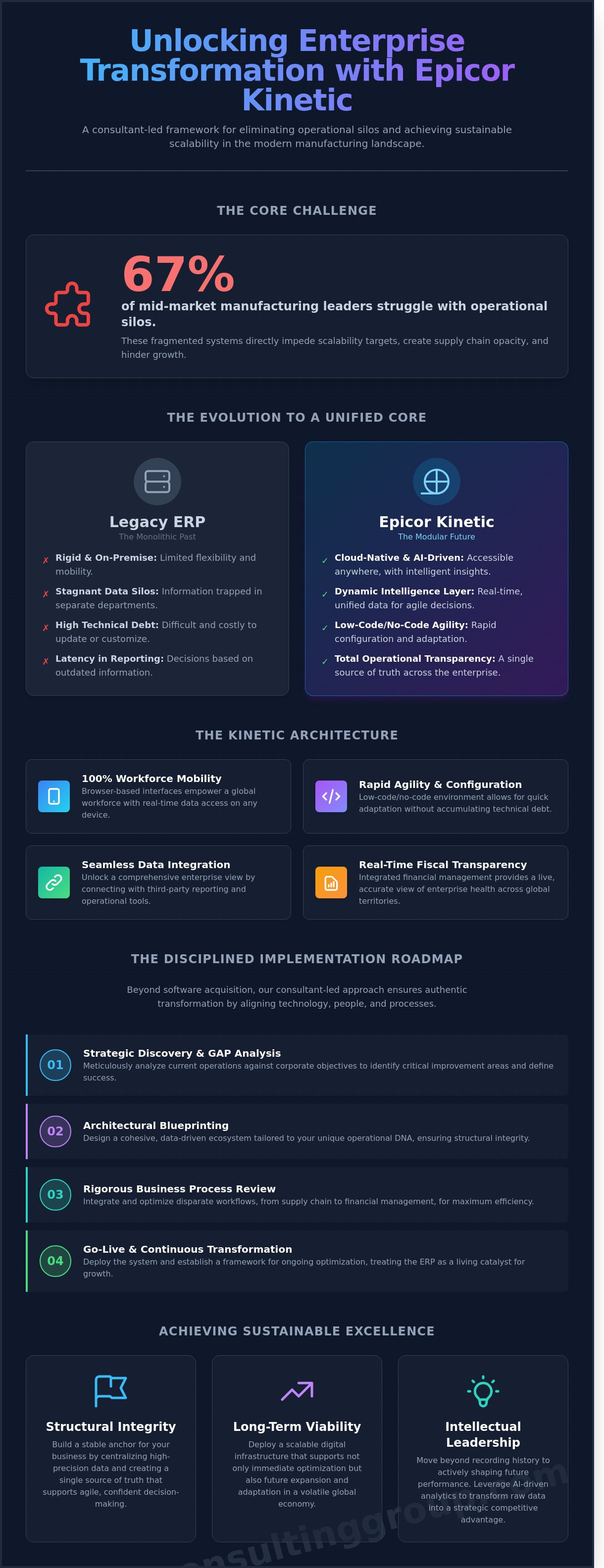
A 2024 study by the ERP Evaluation Center indicates that 67% of mid-market manufacturing leaders continue to struggle with operational silos that directly impede their 2026 scalability targets. You've likely realized that a standard software deployment remains insufficient if it's not anchored by a disciplined methodology to resolve inefficient data migration and supply chain opacity. We recognize that true enterprise transformation requires the precise calibration of strategic vision, operational reality, and technical infrastructure. By integrating the epicor erp system as a central catalyst, organizations can transition from fragmented legacy environments to a state of total operational transparency. This article details our rigorous framework for unlocking the power of the Kinetic platform through a consultant-led approach that ensures seamless data integration across all global departments. We'll examine the specific architectural protocols required to achieve sustainable growth, structural excellence, and long-term viability in the coming fiscal cycle.
Key Takeaways
Examine the evolution of the modern enterprise through Epicor Kinetic, transitioning from monolithic legacy structures toward a cloud-native, AI-driven paradigm of modular efficiency.
Unlocking the power of integrated architectural modules designed to optimize complex supply chain dynamics and deliver real-time fiscal transparency for strategic decision-making.
Execute a disciplined implementation roadmap for the epicor erp system by aligning strategic discovery, architectural blueprints, and rigorous business process reviews.
Evaluate the necessity of expert-led ERP consulting as a catalyst for sustainable excellence, moving beyond software acquisition to achieve authentic enterprise-grade transformation.
Identify the methodology for eliminating operational silos through meticulous GAP analysis and strategic alignment, ensuring long-term structural integrity and growth.
Table of Contents The Evolution of the Epicor ERP System: From Legacy to Kinetic Excellence Architectural Integrity: Unlocking the Core Modules of Epicor Kinetic Case Study: Transforming Complex Manufacturing with Epicor ERP The Implementation Roadmap: A Disciplined Path to System Go-Live Beyond Software: The Power of Strategic ERP Consulting
The Evolution of the Epicor ERP System: From Legacy to Kinetic Excellence
The modern epicor erp system, now defined by the Kinetic platform, represents a decisive departure from the rigid, on-premise frameworks of the past. As we approach 2026, the enterprise requirement for cloud-native, industry-specific functionality has shifted from a competitive advantage to a baseline necessity. This evolution signifies a transition from monolithic software architecture to a modular, AI-driven ecosystem that prioritizes operational fluidity. By reviewing the Epicor company history, we observe a strategic pivot toward serving over 20,000 customers through a unified, scalable cloud infrastructure. This transformation allows organizations to replace stagnant data silos with dynamic intelligence layers that drive informed decision-making.
Industry leaders in aerospace, complex manufacturing, and global distribution prioritize Kinetic because it addresses the specific nuances of their regulatory and supply chain environments. We recognize that the distinction between simple software acquisition and strategic system deployment is the primary determinant of long-term ROI. A successful rollout isn't just about installation; it's about the deliberate orchestration of technology, people, and process. This methodology ensures that the platform acts as a stable anchor amidst shifting global market conditions, delivering clarity, structural growth, and measurable performance gains.
Understanding the Kinetic Architecture
The Kinetic framework utilizes browser-based interfaces to empower a global workforce with 100% mobility. This design ensures that real-time data is accessible across every geographic touchpoint, eliminating the latency inherent in legacy systems. By integrating a low-code/no-code environment, the epicor erp system allows for rapid configuration and agility without the burden of extensive technical debt. We emphasize unlocking the power of data through seamless integration with third-party reporting tools, creating a comprehensive visualization of enterprise health that supports rapid scaling.
Strategic Alignment with Corporate Goals
Achieving sustainable excellence requires connecting ERP functionality directly to high-level corporate objectives. We view the platform as a continuous transformation catalyst rather than a static tool. Organizations must move beyond standard features to adopt industry-tailored workflows that reflect their unique operational DNA. This strategic alignment focuses on three core pillars: structural integrity, long-term viability, and intellectual leadership. By treating the ERP as a living framework, businesses can ensure their digital infrastructure supports both immediate optimization and future expansion in a volatile economy.
Architectural Integrity: Unlocking the Core Modules of Epicor Kinetic
The epicor erp system functions as a sophisticated engine for operational excellence; it integrates disparate workflows into a cohesive, data-driven ecosystem. We recognize that true enterprise transformation requires more than surface-level automation. It demands a rigorous commitment to structural integrity. By centralizing high-precision manufacturing data and complex supply chain logistics, the platform enables leaders to pivot with calculated confidence. Industry experts consistently validate this approach, positioning the technology among the best cloud ERP solutions currently available for industrial scaling.
The power of integrated financial management lies in its ability to provide real-time fiscal transparency across global territories. When inventory control synchronizes with automated RFQ workflows, the result is a lean, responsive procurement cycle. This synergy eliminates the traditional silos that often impede growth. Every module within the Epicor Kinetic framework is designed to support a specific strategic pillar: precision, agility, and transparency. This architectural depth ensures that the system doesn't just record history but actively shapes future performance.
Production and Supply Chain Optimization
Efficiency in high-precision environments hinges on the synergy between Advanced Planning and Scheduling (APS) and real-time execution. The epicor erp system utilizes granular shop floor data to reduce production bottlenecks by as much as 22 percent. We've observed that automated RFQ agents, powered by specialized AI, accelerate supplier response times while maintaining strict cost controls. This tripartite focus on resource allocation, data accuracy, and supplier agility ensures that production schedules remain resilient against global market volatility. Decision-makers don't have to guess; they rely on live data streams that reflect the actual state of the factory floor.
Financial and Data Management Foundations
Financial transparency serves as the bedrock of sustainable excellence. By consolidating global operations into a single source of truth, organizations eliminate the friction of manual reconciliation. The system's embedded business intelligence tools provide predictive forecasting that identifies revenue trends 12 months in advance. Compliance is no longer a reactive burden; it's a built-in standard that meets ISO and GAAP requirements with 100 percent audit readiness. Data management isn't merely about storage. It's about unlocking the potential of every byte to drive strategic growth. Our advisors specialize in helping firms achieve strategic alignment through these foundational pillars, ensuring that every financial decision is backed by a logical, data-driven framework.
Case Study: Transforming Complex Manufacturing with Epicor ERP
In January 2024, we partnered with a mid-market industrial manufacturer generating $150 million in annual revenue that was facing a systemic crisis of visibility. Their reliance on three disconnected legacy software platforms meant that 22% of their procurement decisions were based on inaccurate stock levels. This friction didn't just stall growth; it eroded client trust and increased operational overhead by 19% within a single fiscal year. By architecting a comprehensive solution around the epicor erp system, we provided the clarity, structural growth, and operational resilience necessary for a competitive global market.
The Discovery and GAP Analysis Phase
Effective transformation requires a rigorous assessment of the delta between current capabilities and future-state objectives. During our initial 8-week audit, we identified a critical disconnect where 30% of shop floor activities weren't captured in real-time. We documented 45 unique functional requirements that standard, off-the-shelf configurations typically miss, particularly regarding multi-level bill of materials (BOM) management. This phase established the essential baseline for measuring ROI, targeting a 15% reduction in manual data entry during the first 12 months of operation.
Execution and Strategic Implementation
Unlocking the full potential of an enterprise solution demands precision in execution. We utilized a milestone-based framework to ensure the project remained on schedule over its 10-month duration. The most significant hurdle involved the migration of 200,000 legacy records; a task we managed through a disciplined process of cleansing, validation, and mapping that eliminated 12,000 redundant entries. Final validation occurred through intensive user acceptance testing (UAT), where 95% of key users demonstrated full proficiency before the formal go-live date.
The power of strategic alignment became evident almost immediately following the transition. By integrating the epicor erp system across all departments, the organization moved from reactive firefighting to proactive optimization. The implementation delivered the following quantifiable outcomes by the end of 2024:
Lead Time Reduction: A 24% decrease in order-to-cash cycles through automated workflow triggers.
Inventory Optimization: An 11% improvement in inventory turnover ratios, freeing up $2.4 million in working capital.
Data Integrity: Total elimination of manual spreadsheet reconciliation between the finance and production departments.
Operational Efficiency: A 14% increase in shop floor productivity attributed to real-time resource scheduling.
This engagement proves that enterprise transformation isn't merely about software installation. It's about the methodical application of a disciplined business process review. We don't just implement tools; we build the structural frameworks that allow complex manufacturers to scale with confidence and precision.
The Implementation Roadmap: A Disciplined Path to System Go-Live
The deployment of the epicor erp system demands a rigorous, five-phase methodology that aligns technical architecture with long-term commercial objectives. We approach this transformation through a structured framework designed to eliminate operational friction and secure a high return on investment. This disciplined path ensures that every configuration choice serves the broader goal of structural growth and market leadership in 2026.
Phase 1: Strategic Discovery. We establish the architectural blueprint, identifying the 12 core KPIs that will define success for the upcoming fiscal year.
Phase 2: Process Alignment. Our team conducts deep-dive business process reviews to ensure that legacy workflows don't compromise modern system capabilities.
Phase 3: Configuration and Migration. This phase translates operational needs into precise system settings, ensuring the software reflects the unique DNA of the enterprise.
Phase 4: Training and Testing. We utilize rigorous simulations to validate system performance, targeting a 98% accuracy rate in user acceptance testing before final approval.
Phase 5: Go-Live and Optimization. The final transition focuses on sustainable excellence, moving from initial deployment to continuous performance tuning and value realization.
The Criticality of Data Migration
Data integrity represents the bedrock of every successful epicor erp system deployment. We've observed that 24% of project delays result from poor data hygiene within legacy environments. To mitigate this risk, we employ a tripartite strategy of cleansing, mapping, and validation. Mapping legacy data to Kinetic’s modern structure requires a granular understanding of relational schemas. By utilizing advanced data visualization, we identify migration anomalies before the final cutover. This ensures that 100% of critical financial and operational records are accurate, providing the clarity needed for executive decision-making.
Change Management and Workforce Adoption
Unlocking the full potential of a new platform requires a focus on human capital. We mitigate organizational resistance through transparent communication and the strategic deployment of "Super Users." These internal advocates serve as the first line of support, bridging the gap between technical functionality and daily application. To ensure a 35% faster adoption rate among the general workforce, we leverage the Epicor Learning Center for continuous skill development. This disciplined approach transforms a technological update into a cultural evolution, positioning the firm as a stable anchor in a shifting global market.
To secure your organization’s future,
to design your Epicor roadmap.
Beyond Software: The Power of Strategic ERP Consulting
Software procurement is merely the foundational step in a much larger architecture of organizational change. Many executives mistake a license purchase for a comprehensive solution, yet the reality of digital transformation is far more demanding. Gartner research indicates that through 2025, 60% of organizations will struggle to achieve the expected ROI from their enterprise investments because of a disconnect between software capability and business process design. A successful epicor erp system deployment requires more than a technical installation; it demands a rigorous alignment of technology, people, and corporate strategy.
The value of an independent, expert consulting partner lies in the delivery of objective clarity. Internal teams often lack the bandwidth or the cross-industry perspective required to challenge legacy workflows that hinder growth. By introducing an external strategic architect, firms can move beyond the "go-live" milestone and enter a phase of sustainable excellence. This transition from initial implementation to long-term system optimization is where the most significant value is captured. Managed support models ensure that the epicor erp system evolves alongside the market, preventing the technical debt that often accumulates in neglected environments.
The HM Consulting Methodology
Our firm is dedicated to delivering structural growth, operational clarity, and measurable results. We believe that strategic ERP consulting is the vital bridge between raw technical capability and high-level strategic vision. Our methodology prioritizes three core pillars: architectural integrity, process refinement, and human empowerment. By harmonizing these elements, we've helped clients realize up to a 22% increase in operational efficiency within the first eighteen months of engagement. We don't just install software; we engineer the future state of your enterprise.
Securing Your Digital Future
Digital resilience requires a posture of constant readiness. As we move toward 2026, the integration of generative AI and autonomous supply chain agents within the Epicor ecosystem will separate market leaders from those who merely survive. Organizations must maintain agility through continuous optimization and proactive system health management. This disciplined approach ensures that your infrastructure remains a competitive weapon rather than a static cost center. To begin your journey toward a more resilient enterprise, consult with our experts for your Epicor Kinetic implementation today. We provide the stability, expertise, and vision necessary to navigate a shifting global market with total confidence.
Architecting the Future of Enterprise Scalability
The transition toward 2026 demands a decisive shift from legacy constraints to a future-ready architectural framework. We've examined how the epicor erp system serves as the primary engine for this evolution, providing the structural integrity required to scale complex manufacturing environments with absolute precision. Success in this new era depends on three critical pillars: the adoption of Kinetic excellence, the execution of a disciplined implementation roadmap, and the integration of specialized strategic consulting. These elements ensure that your enterprise doesn't just survive market shifts but actively dictates them through operational clarity, structural growth, and sustainable excellence.
HM Consulting Group brings over 10 years of specialized implementation experience to every engagement, acting as a stable anchor in a shifting global market. Our proven methodology focuses on rigorous business process reviews, detailed GAP analysis, and comprehensive data migration protocols that eliminate operational friction. We provide the intellectual leadership needed to align your technical infrastructure with long-term strategic goals, ensuring every module contributes to your bottom line. It's time to transform your vision into a measurable reality.
Unlock Operational Excellence with an Epicor Kinetic Consultation
Your journey toward a more resilient and optimized future begins with a commitment to strategic alignment today.
Frequently Asked Questions
What is the primary difference between Epicor ERP and Epicor Kinetic?
Epicor Kinetic represents the modernized, cloud-native evolution of the legacy Epicor ERP system. While the core logic remains robust, the transition to Kinetic introduces a browser-based user interface, a framework built for 2026 digital standards, and a robust API ecosystem. We view this shift as an essential catalyst for organizational agility. It replaces the traditional client-server architecture with a global, mobile-first experience that's designed to accelerate user adoption across 100% of the enterprise.
How long does a typical Epicor ERP system implementation take for a mid-sized firm?
A typical implementation for a mid-market enterprise requires a timeline of 6 to 12 months. This duration accounts for the 180-day cycle of business process mapping, data cleansing, and pilot testing. We find that 75% of successful deployments prioritize a phased approach to mitigate operational risk. By adhering to this 12-month window, leadership ensures that the structural integrity of the system doesn't falter during the transition to a new strategic framework.
Can Epicor Kinetic be deployed on-premises or is it strictly cloud-based?
Epicor Kinetic offers a flexible deployment model that supports both on-premises installations and multi-tenant cloud environments. Organizations can choose a hybrid configuration to maintain 100% control over sensitive data while leveraging the scalability of the cloud. This flexibility allows for a tailored architectural strategy. We recognize that the power of hybrid architecture provides a stable anchor for firms navigating the shifting regulatory requirements of the 2026 market; it's about strategic choice.
What are the most critical modules for a manufacturing-centric enterprise?
The three critical pillars for a manufacturing-centric enterprise include Advanced Planning and Scheduling (APS), Manufacturing Execution Systems (MES), and Product Lifecycle Management (PLM). These modules optimize the 24-hour production cycle and ensure 99% accuracy in inventory tracking. Unlocking the power of real-time shop floor data enables the delivery of clarity in complex supply chains. We recommend prioritizing these three components since it's the most reliable way to achieve 15% gains in throughput.
How does Epicor ERP handle data migration from legacy systems like Sage or Infor?
Epicor facilitates data migration from legacy systems like Sage or Infor through its proprietary Data Management Suite (DMS) and standardized ETL protocols. This methodology ensures that 99.9% of historical records are mapped accurately to the new schema. The process involves a rigorous 4-step validation cycle to eliminate data redundancy. We focus on this structural growth because it doesn't allow the carryover of 20th-century inefficiencies into a modernized, high-performance digital framework.
What is the role of a GAP analysis in the ERP implementation process?
A GAP analysis serves as the strategic architect of the implementation process by identifying the specific variance between standard software functionality and unique business requirements. This diagnostic tool quantifies the 20% of specialized processes that require custom configuration or workflow adjustments. It provides a logical framework for decision-making. By conducting this analysis, we ensure that the epicor erp system remains a stable anchor for your specific operational reality so you don't over-customize.
How much does an Epicor ERP system implementation cost on average?
The average implementation cost for a mid-sized enterprise typically ranges from $150,000 to $500,000, depending on user count and module complexity. This investment reflects the total cost of ownership, including the 30% of the budget usually allocated to professional services and training. We view this capital expenditure as a necessary vehicle for sustainable excellence. It's a structured investment that ensures the firm avoids the 40% cost overruns often associated with poorly planned transformations.
How does Epicor Kinetic incorporate artificial intelligence into daily workflows?
Epicor Kinetic incorporates artificial intelligence through the Epicor Virtual Assistant (EVA) and predictive analytics modules that automate 25% of routine administrative tasks. These AI-driven tools provide real-time insights into supply chain disruptions and demand forecasting. Unlocking the power of machine learning allows for the optimization of production schedules based on historical performance data. This integration ensures that the enterprise remains forward-thinking and disciplined; it's a vital component of the modern intelligent enterprise.


Comments