

The Strategic Architect: A Comprehensive Guide to ERP Consulting in 2026
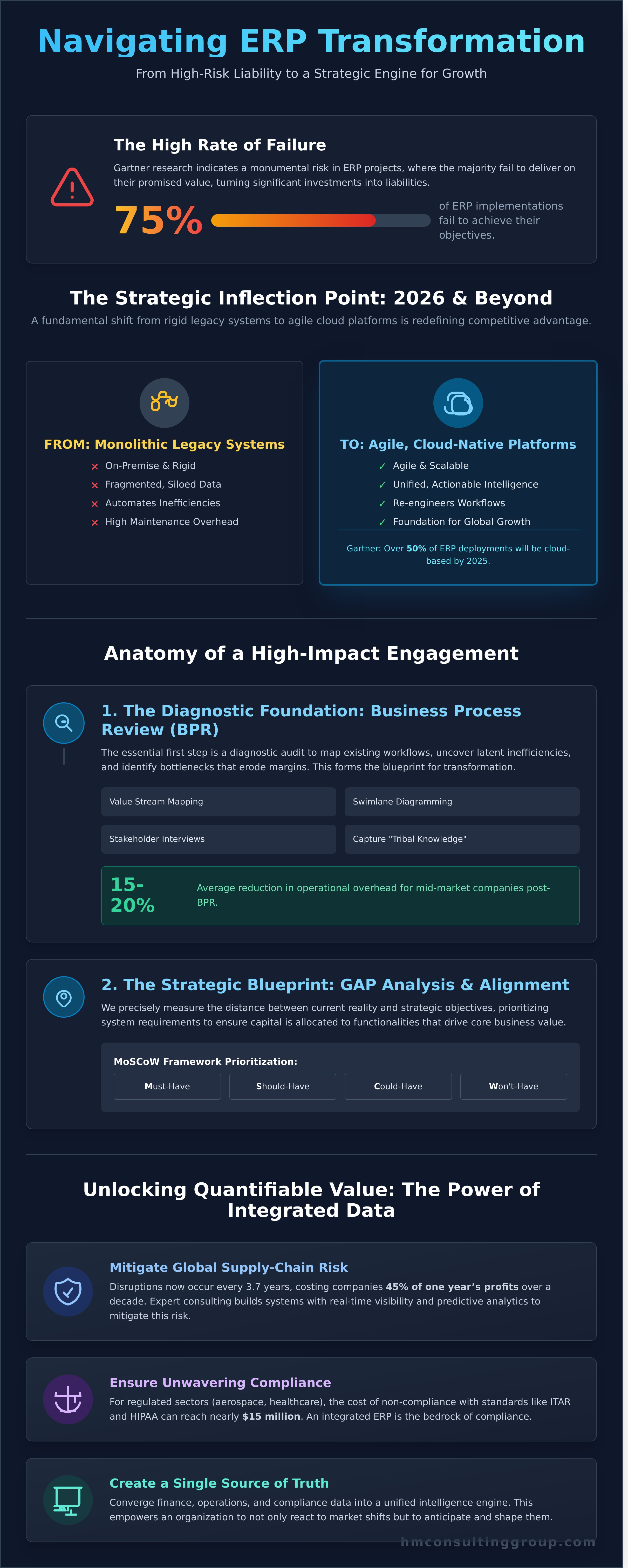
Gartner research indicates that as many as 75% of ERP implementations fail to achieve their intended objectives. This stark reality validates a pervasive executive concern; the fear that a monumental investment in complex ERP platforms will become a high-stakes liability instead of a catalyst for transformation is well-founded, particularly when confronted with operational fragmentation and a lack of specialized internal expertise.
This guide is engineered to provide clarity and strategic direction. We will demonstrate how elite erp consulting functions as the essential architectural force, capable of converting disparate processes into a cohesive, powerful engine for sustainable global growth. Within this comprehensive overview, you will discover the frameworks for achieving strategic alignment between IT and business goals, a clear roadmap for phased and successful implementation, and the precise methodologies required to secure a measurable return on your technological investment.
Key Takeaways
Understand the critical shift from monolithic legacy systems to agile, cloud-native platforms and why this redefines corporate strategy for 2026.
Develop a robust framework for evaluating consulting firms, enabling you to distinguish between a true strategic partner and a mere software installer.
Grasp the essential components of a high-impact engagement, beginning with the Business Process Review (BPR) as the diagnostic foundation for transformation.
Discover how strategic erp consulting transforms siloed operational data into a unified, actionable intelligence engine that drives sustainable global growth.
Table of Contents The Strategic Imperative of ERP Consulting in 2026 The Anatomy of High-Impact ERP Advisory Services Evaluating ERP Consulting Firms: A Framework for Selection Navigating the ERP Implementation Lifecycle Unlocking Sustainable Excellence: The HM Consulting Methodology
The Strategic Imperative of ERP Consulting in 2026
In the evolving economic theater of 2026, enterprise technology is no longer a peripheral support function; it is the central nervous system of competitive advantage. The practice of erp consulting has transcended its historical definition as mere technical implementation. It now represents the critical intersection of high-level management advisory and disciplined technical execution. While the foundational definition of Enterprise resource planning (ERP) centers on the integration of core business processes, its strategic application is what separates market leaders from the laggards. We are witnessing a decisive migration away from monolithic, on-premise legacy systems toward agile, cloud-native environments like Epicor Kinetic, a shift Gartner forecasts will see over 50% of all ERP deployments become cloud-based by 2025. This technological inflection point demands a partner who provides more than software. It demands a stable anchor capable of delivering a tripartite value proposition: strategic clarity, accelerated structural growth, and sustainable operational excellence.
Beyond Installation: The Consultant as a Strategic Architect
Software vendors are incentivized to showcase product features; our focus is engineered for business outcomes. An "out-of-the-box" implementation risks automating existing inefficiencies, creating a faster version of a flawed process. The true risk lies in this misalignment, where millions in technology investment fail to generate a commensurate return. Intellectual leadership in this domain means architecting a solution that re-engineers workflows, aligns departmental objectives, and builds a scalable foundation for future market penetration.
Unlocking Efficiency in Complex Global Markets
The modern enterprise operates within a framework of unprecedented volatility. A 2023 McKinsey survey revealed that significant supply-chain disruptions now occur every 3.7 years, costing companies an average of 45% of one year’s profits over a decade. Expert ERP consulting directly mitigates this risk by designing systems that provide real-time visibility and predictive analytics. For Northeast US companies in heavily regulated sectors like aerospace and healthcare, this extends to ensuring unwavering compliance with standards such as ITAR and HIPAA, where the average cost of non-compliance can reach nearly $15 million. It’s here we unlock what we call The Power of Integrated Data. When finance, operations, and compliance data streams converge into a single source of truth, an organization gains the intelligence to not only react to market shifts but to anticipate and shape them. This is the ultimate competitive advantage.
The Anatomy of High-Impact ERP Advisory Services
A successful enterprise transformation is not a product of technology alone; it is the outcome of a meticulously architected engagement. High-impact ERP advisory services move beyond simple implementation to provide a strategic framework for discovery, alignment, and sustainable growth. This process deconstructs an organization's operational DNA to build a new central nervous system, ensuring that the technological investment yields quantifiable returns and a durable competitive advantage. The engagement's success is predicated on three core pillars: a rigorous diagnostic phase, a clear strategic alignment, and an uncompromising approach to data integrity.
The Business Process Review: A Catalyst for Clarity
Our methodology begins with an exhaustive Business Process Review (BPR), a diagnostic audit designed to map existing workflows and uncover latent inefficiencies. We deploy techniques like value stream mapping and swimlane diagramming to visualize every touchpoint, from procurement to final delivery, identifying operational bottlenecks that erode margin. A critical component of this discovery involves structured stakeholder interviews, which are essential for capturing the undocumented "tribal knowledge" that formal process charts often miss. Our analysis consistently reveals process redundancies that, once optimized, can reduce operational overhead by an average of 15-20% for mid-market companies in the Northeast. The Business Process Review is the foundational blueprint upon which all subsequent system configurations and strategic alignments are built.
GAP Analysis and Strategic Alignment
Following the BPR, we conduct a comprehensive GAP Analysis to precisely measure the distance between your current operational reality and your strategic objectives. This isn't merely a technical exercise; it's a strategic prioritization of capabilities. We utilize a MoSCoW framework (Must-Have, Should-Have, Could-Have, Won't-Have) to categorize system requirements, ensuring that capital and resources are allocated to functionalities that drive core business value. The consultant’s role here is pivotal, acting as the essential mediator between IT’s technical capabilities and the functional needs of operational departments. Every proposed customization is rigorously vetted against a simple question: does this serve a long-term, strategic business objective? According to a 2023 KPMG report, customizations lacking this direct strategic link are 65% more likely to become costly technical debt within 36 months.
The final, and perhaps most critical, element of this strategic foundation is data management. An ERP system is only as powerful as the data that fuels it, making a disciplined data migration strategy non-negotiable. Effective erp consulting prioritizes a tripartite strategy of data cleansing, precise data mapping, and phased, secure migration to protect operational continuity. This phase is often the most complex part of the entire ERP implementation process, where even minor errors in mapping financial or inventory data can have cascading consequences. We mitigate this risk through validated sandbox environments and a zero-tolerance policy for data corruption, ensuring the integrity of your most valuable asset. Understanding these foundational elements is the first step toward transformation. Explore our methodology to see how we translate these strategic principles into tangible growth for our clients.
Evaluating ERP Consulting Firms: A Framework for Selection
Selecting an ERP partner is a critical inflection point in your company’s growth trajectory. The distinction between a tactical software installer and a genuine strategic partner is profound, yet often obscured. The former delivers a product; the latter architect's a transformation. A robust evaluation framework must therefore move beyond technical checklists to scrutinize a firm’s industry pedigree, its quantifiable value proposition, and its commitment to a truly collaborative partnership model. This is the foundation upon which successful digital transformation is built.
The Pedigree of Expertise: Why Specialization Matters
A generalist IT firm cannot grasp the intricate operational realities of a Northeast US manufacturer or distributor. Their one-size-fits-all approach inevitably fails to optimize the nuanced workflows within platforms like Epicor Kinetic, leading to compromised functionality and unrealized potential. A partner with a decade-plus track record in your specific sector brings an institutional knowledge that is simply irreplaceable. They understand your challenges not as abstract problems, but as lived operational hurdles. This depth of experience is what enables a commitment to "Sustainable Excellence," designing a system that evolves with your business rather than a quick fix that creates long-term technical debt.
Quantifying the Value of ERP Implementation Services
The most common objection to professional erp consulting is its cost. This perspective, however, fundamentally misframes the investment. The true financial calculus is not about the initial fee, but about the tangible, measurable return on investment it generates. A strategic implementation is designed to deliver specific, targeted outcomes that directly impact your bottom line. The hidden costs of a poorly executed, "cheaper" implementation are catastrophic, manifesting as operational downtime, fractured data integrity, and critically low user adoption. These failures are well-documented, and the lessons learned from ERP implementations in other complex sectors underscore the universal risks of underinvestment in expertise.
We view the consulting investment through a lens of risk mitigation and value creation. Consider the following performance indicators:
Reduced Operational Cycle Times: A targeted 15-20% reduction in order-to-cash cycles by eliminating process bottlenecks.
Improved Inventory Accuracy: Elevating inventory record accuracy from an industry average of 85% to a best-in-class 99.5%, directly reducing carrying costs.
Data-Driven Strategic Insights: Unlocking real-time Overall Equipment Effectiveness (OEE) metrics to drive continuous improvement on the shop floor.
Given that industry reports from analysts like the Panorama Consulting Group consistently place ERP project failure rates between 50% and 75%, the consulting fee is not an expense. It is an insurance policy. It's the strategic assurance required to secure your place in the successful 25%.
Ultimately, the selection process culminates in identifying a partner who embraces a "collective we" philosophy. This collaborative model ensures that our team integrates seamlessly with yours, creating a unified force dedicated to a singular objective: your sustained competitive advantage. True erp consulting is not a service you procure; it is a strategic capability you embed within your organization.
Navigating the ERP Implementation Lifecycle
A successful ERP implementation is not a singular event; it is a meticulously orchestrated process of strategic transformation. It demands a disciplined methodology that moves from high-level vision to granular operational reality. Our approach to erp consulting is grounded in a four-phase lifecycle designed to mitigate risk, accelerate value realization, and ensure sustainable excellence. This structured progression guarantees that technological deployment is inextricably linked to core business objectives, transforming your ERP from a software expense into a strategic asset.
The journey begins with Discovery and Diagnostic, a critical phase where we align executive vision with project scope. Through intensive stakeholder workshops and process mapping, we define the precise parameters for success. This blueprint then informs the Configuration and Pilot stage, where our team translates complex business logic into a robust system architecture. Following this, the Data Migration and Integrity phase ensures the system's foundation-your data-is pristine. We employ a rigorous, multi-point validation process because, as a 2022 Gartner report indicates, poor data quality is a primary reason for 40% of all business initiatives failing to achieve their targeted benefits. The final phase, Go-Live and Optimization, marks the transition from project to operation, a continuous cycle of performance tuning and enhancement to maximize your return on investment.
Project Management and Intellectual Rigor
Our methodology is anchored in milestone-based execution, ensuring project momentum and budget adherence are maintained with uncompromising discipline. Real-time project health is monitored through advanced data visualization dashboards, providing stakeholders with transparent progress reports. Yet, technology is only half the equation. We place immense focus on the human element through structured user training and organizational change management, recognizing that projects with excellent change management are, according to Prosci's 2023 research, six times more likely to meet or exceed objectives.
The Power of Data Visualization and Reporting
We empower clients to move beyond basic reporting into the realm of predictive analytics and dynamic executive dashboards. For manufacturers in the Northeast, Epicor Kinetic becomes the engine of a "Data-First" culture, translating raw shop-floor data into a clear, competitive advantage. Our custom reporting frameworks are designed to unlock actionable insights, transforming complex datasets into strategic intelligence that drives decisive leadership and fosters a culture of continuous improvement across the enterprise.
This structured, data-driven implementation process is the core of effective erp consulting. It ensures that every decision, from initial configuration to post-launch optimization, is aligned with your long-term growth strategy. To ensure your implementation is managed with this level of strategic precision, schedule a diagnostic consultation with our ERP specialists.
Unlocking Sustainable Excellence: The HM Consulting Methodology
A successful ERP implementation isn't the final objective; it's the foundational platform for sustained operational growth. At H.M. Consulting Group, our methodology transcends standard deployment. We engage in Strategic Architecting, a disciplined process designed for the complex industrial ecosystems of the Northeast and Mid-Atlantic. We transform operational ambiguity into structural clarity, delivering a framework built for resilience, scalability, and competitive dominance in your market.
Epicor Kinetic Specialization: A Targeted Approach
Our deep-rooted expertise in Epicor's software architecture allows us to engineer solutions, not just configure them. For clients in Aerospace, this means tailoring Kinetic to achieve AS9100 compliance. In Healthcare, we ensure strict adherence to FDA 21 CFR Part 11 for device traceability. For Distribution leaders, we unlock The Power of Optimization, achieving an average of 15% reduction in inventory carrying costs for our partners through advanced WMS integration.
This focused specialization ensures your ERP isn't a generic tool but a high-performance engine calibrated to your specific industry demands. Our approach to erp consulting is predicated on the principle that the system must serve the strategy, not the other way around. We map every workflow and data point to your core business objectives, ensuring a direct line from technological investment to measurable ROI. Organizations that partner with us for post-implementation optimization report a 30% greater return on their technology investment within 24 months of go-live.
The journey from operational complexity to structural clarity is a deliberate one. It involves three core phases:
Diagnostic & Architectural Design: A comprehensive business process review to identify inefficiencies and design a future-state workflow that aligns technology with strategic goals.
Precision Implementation: A structured, milestone-driven deployment managed by senior consultants to mitigate risk and ensure a seamless transition with minimal operational disruption.
Continuous Optimization: A post-launch partnership focused on refining system performance, driving user adoption, and evolving the platform as your business grows.
The Path Forward: Securing Your Organizational Future
The end of implementation marks the beginning of continuous improvement. Your market won't stand still, and neither should your central operating system. Our managed support retainers ensure system longevity and strategic agility, providing consistent access to senior-level consultants who help you adapt, evolve, and capitalize on new opportunities. This proactive partnership is the key to securing your organization’s future in a dynamic economy.
We guide organizations from a state of disparate processes to one of integrated intelligence, establishing the foundation for enduring success. This transformation is the core of our commitment. Ready to architect your future? Contact H.M. Consulting Group to begin your Business Process Review today.
Architecting Your Strategic Advantage for 2026 and Beyond
The operational landscape of 2026 demands a fundamental paradigm shift in erp consulting. Success is no longer contingent solely upon technological deployment; it is predicated on the strategic alignment of your ERP system with core business objectives. This evolution requires a meticulous partner selection framework, moving beyond tactical implementation to holistic business transformation. It's about converting your digital core into a decisive competitive weapon.
At HM Consulting Group, we embody this new paradigm. With over a decade of specialized Epicor Kinetic expertise, we have established a proven track record delivering transformative results within the high-stakes Manufacturing and Aerospace sectors. Our comprehensive Business Process Review (BPR) methodology isn't just a step in our process; it’s the foundational blueprint for unlocking sustainable excellence.
Your enterprise transformation requires more than a vendor; it demands a strategic architect. Partner with the Strategic Architects at HM Consulting Group to begin engineering your competitive advantage for the decade ahead.
Frequently Asked Questions About ERP Consulting
What does an ERP consultant actually do?
An ERP consultant functions as a strategic architect, technical executor, and change management leader for your system implementation. We analyze your current business processes, identify operational inefficiencies, and design a tailored ERP solution that aligns with your long-term growth objectives. This encompasses everything from software selection and system configuration to user training and post-launch optimization, ensuring the technology drives measurable business transformation.
How much do ERP consulting services typically cost in 2026?
In 2026, ERP consulting rates in the Northeast US typically range from $175 to $350 per hour, contingent on consultant experience and project complexity. A mid-market implementation project, spanning 6-9 months, generally falls between $150,000 and $750,000 in total consulting fees. This investment covers critical phases like discovery, configuration, and data migration. We provide a detailed scope of work to ensure complete cost transparency and strategic budget alignment.
Why should we hire an ERP consultant instead of using the software vendor?
Hiring an independent ERP consultant provides objective, unbiased guidance focused solely on your business outcomes, not on selling a specific software. While vendors possess deep product knowledge, their primary objective is implementing their platform. We act as your dedicated advocate, ensuring the chosen ERP system is configured to optimize your unique workflows. Our allegiance is to your ROI, providing a level of strategic oversight that a vendor’s standard package rarely includes.
How long does a typical ERP implementation take with a consulting firm?
A typical mid-market ERP implementation with a consulting firm takes between 6 and 12 months from project kickoff to go-live. This timeline is segmented into distinct phases: strategic planning and discovery (1-2 months), system design and configuration (3-5 months), and data migration, testing, and training (2-5 months). Accelerating this process without proper diligence often results in a 45% higher rate of scope creep and user adoption issues, which our structured methodology prevents.
What is a Business Process Review (BPR), and is it necessary?
A Business Process Review (BPR) is a comprehensive analysis of your current operational workflows, and it is an indispensable first step for successful ERP implementation. The BPR is not merely a procedural step; it’s the foundation of your digital transformation. By mapping existing processes, we identify bottlenecks, allowing us to redesign workflows for optimal efficiency. Skipping this phase often means replicating inefficient processes in a new system, negating up to 60% of the potential ROI.
Can an ERP consultant help with data migration from legacy systems?
Yes, managing complex data migration is a core competency of our erp consulting practice. We orchestrate the entire data migration lifecycle, which includes data extraction, cleansing, transformation, and validation to ensure 99.9% accuracy upon import into the new system. Our structured approach mitigates the significant risks associated with this phase, such as data corruption or operational downtime. Unlocking the power of your historical data requires this meticulous, expert-led process for a seamless transition.
What industries benefit most from Epicor Kinetic consulting?
Industries with complex manufacturing, distribution, and supply chain operations derive the greatest value from Epicor Kinetic consulting. Specifically, we see transformative results for clients in discrete manufacturing, industrial machinery, and fabricated metals across the Northeast. These sectors leverage Epicor Kinetic’s robust capabilities for shop floor control and quality management, achieving an average of 15-20% improvement in operational efficiency within 18 months post-implementation.
How do we measure the success of an ERP consulting engagement?
We measure success through a predefined set of Key Performance Indicators (KPIs) tied directly to your strategic business objectives. Success isn't just a successful go-live; it's a quantifiable business transformation. Prior to engagement, we establish benchmarks for metrics like inventory turn reduction (e.g., a 25% decrease) or order-to-cash cycle time improvement (e.g., a 3-day reduction). These metrics provide an objective framework for evaluating the project's ROI.


Comments