
The Strategic Architect: A Comprehensive Guide to ERP Software Consulting in 2026
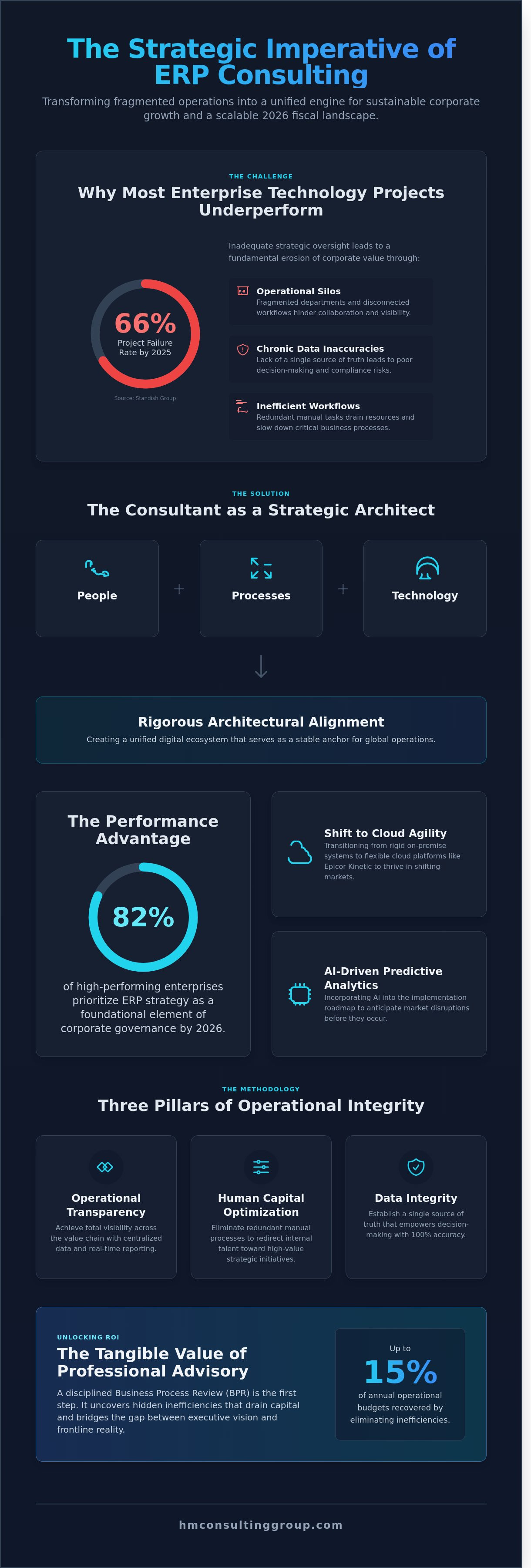
By the close of 2025, research from the Standish Group indicates that 66% of enterprise technology projects will experience total or partial failure due to inadequate strategic oversight. You likely recognize that operational silos, chronic data inaccuracies, and the rising costs of inefficient workflows aren't merely technical glitches; they represent a fundamental erosion of corporate agility and long-term value. We believe that high-level erp software consulting shouldn't be viewed as a simple software procurement, but as the rigorous architectural alignment of people, processes, and technology. This comprehensive guide demonstrates how expert intervention transforms fragmented operations into a unified engine for sustainable corporate growth. We'll examine the specific frameworks required for unlocking the power of seamless system integration, achieving measurable ROI through optimization, and establishing the structural integrity needed for a scalable 2026 fiscal landscape. Through a methodical approach to business transformation, we provide the clarity and structural growth your organization requires to remain a stable anchor in a shifting global market.
Key Takeaways
Understand the role of the strategic architect in aligning organizational workflows with integrated solutions to ensure structural integrity and long-term viability.
Master a disciplined methodology where technical configuration is driven by rigorous business requirements, ensuring that erp software consulting serves as a catalyst for operational precision.
Evaluate the critical distinctions between vendor-agnostic generalists and specialized experts to mitigate the hidden risks of technical hurdles and surface-level advisory.
Quantify the tangible ROI of professional advisory by implementing frameworks that eliminate scope creep and ensure the achievement of strategic project milestones.
Unlock the power of sustainable excellence through specialized Epicor Kinetic transformation, positioning your enterprise for clarity, growth, and global competitiveness.
Table of Contents What is ERP Software Consulting? Defining the Strategic Architect The Consulting Methodology: From Diagnostic Review to Strategic Blueprint Independent Advisory vs. Ecosystem Mastery: Navigating the Consultant Landscape Unlocking ROI: The Tangible Value of Professional ERP Advisory The HM Consulting Group Advantage: Unlocking Sustainable Excellence
What is ERP Software Consulting? Defining the Strategic Architect
At its core, Enterprise Resource Planning (ERP) consulting represents the sophisticated alignment of organizational workflows with integrated digital solutions. It's a discipline that transcends simple software installation. We define the consultant as a strategic architect who bridges the gap between fragmented legacy silos and a unified digital ecosystem. This process requires a mastery of business process engineering, rigorous risk management, and strategic change leadership to ensure long-term viability.
Elite global firms no longer view erp software consulting as a reactive IT expenditure. Instead, they recognize it as a proactive investment in structural growth. By 2026, data from leading industry analysts suggests that 82% of high-performing enterprises prioritize ERP strategy as a foundational element of their corporate governance. This perspective shifts the focus from technical troubleshooting to the creation of a stable anchor for global operations. It's about building a framework that supports scalable expansion rather than just fixing current operational bottlenecks.
The Core Objectives of ERP Advisory
Our methodology focuses on three critical pillars of operational integrity. We prioritize these objectives to ensure that the transition delivers measurable clarity and structural growth:
Operational Transparency: Achieving total visibility across the value chain through centralized data management and real-time reporting.
Human Capital Optimization: Eliminating redundant manual processes to redirect internal talent toward high-value strategic initiatives.
Data Integrity: Establishing a single source of truth that empowers executive-level decision-making with 100% accuracy in financial and operational records.
The Evolution of ERP Strategy in 2026
The transition from on-premise rigidity to cloud-based agility is now absolute. Platforms such as Epicor Kinetic provide the flexibility required to thrive in a shifting global market. Modern erp software consulting now incorporates AI-driven predictive analytics into the initial implementation roadmap, allowing firms to anticipate market disruptions before they occur. This shift underscores the vital role of strategic software implementation services in securing a competitive advantage.
Unlocking the power of a unified digital ecosystem requires a deliberate and thorough approach. We move methodically from broad industry challenges to specific, integrated solutions. This logical progression ensures that the implementation isn't just a technical update but a total business transformation. In a volatile economy, the clarity provided by a well-architected ERP system is the primary driver of sustainable excellence and long-term resilience.
The Consulting Methodology: From Diagnostic Review to Strategic Blueprint
A disciplined methodology transforms a standard software installation into a vehicle for global leadership. We utilize a framework that prioritizes business requirements over technical constraints; this ensures the software serves the organization rather than dictating its limitations. It's a process that demands intellectual rigor, strategic alignment, and operational precision. By integrating project management rigor, we maintain strict timeline stability and budgetary control throughout the engagement. Our approach relies on the power of alignment, precision, and architectural integrity to deliver results that endure long after the initial go-live date.
Phase 1: The Comprehensive Business Process Review (BPR)
We begin with deep-dive interviews across all functional departments to map existing workflows and document every functional requirement. This diagnostic phase uncovers hidden inefficiencies that drain up to 15% of annual operational budgets in decentralized organizations. By capturing the nuances of daily operations, we ensure the final system architecture supports the user's reality, which effectively bridges the gap between executive vision and frontline execution. A 2025 industry report indicated that 64% of ERP projects exceed their budget due to shifting requirements during the build phase; we mitigate this risk through exhaustive upfront documentation.
Phase 2: GAP Analysis and System Design
We evaluate software capabilities against the documented business needs to identify where the system falls short of excellence. This holistic approach to ERP consulting distinguishes between necessary custom configurations and required process adjustments. We create a technical blueprint that prioritizes long-term system stability, strategic alignment, and sustainable excellence. Unlocking the potential of an ERP requires a design that minimizes technical debt while maximizing operational agility. This stage defines the distance between the current state and a future of optimized performance.
Phase 3: Data Management and Migration Strategy
Data integrity remains the cornerstone of any digital transformation. We execute rigorous validation protocols to prevent 'garbage-in, garbage-out' scenarios that plague 22% of new implementations according to recent 2024 benchmarks. Our team maps complex data structures from legacy systems to the new environment with surgical precision, ensuring that historical records remain accessible and accurate. We focus on cleaning legacy data early in the cycle; this ensures that your go-live date is met with accurate, actionable insights rather than technical errors. The result is a clean transition that preserves the organization’s most valuable intellectual assets.
Effective erp software consulting depends on these structured phases to mitigate risk and drive growth. Organizations seeking to refine their internal structures often find that optimizing the strategic roadmap is the most vital step toward achieving long-term scalability.
Independent Advisory vs. Ecosystem Mastery: Navigating the Consultant Landscape
The persistent debate within erp software consulting centers on a false dichotomy: the perceived objectivity of the vendor-agnostic generalist versus the technical precision of the specialized expert. While generalists promise a broad view, they often introduce systemic risk through surface-level knowledge that falters during complex technical hurdles. True strategic alignment requires more than a neutral perspective; it demands a partner who possesses ecosystem mastery. We believe that clarity, structural growth, and sustainable excellence are only achievable when the advisor understands the code as well as the commerce. This intellectual leadership ensures that every recommendation is backed by a logical framework and a pragmatic understanding of system limitations.
Specialized expertise in Epicor enterprise resource planning provides a more robust ROI by eliminating the learning curve associated with complex industrial requirements. Organizations in aerospace, manufacturing, and distribution require a consultant who understands ITAR compliance, lean production cycles, and multi-tier supply chain logistics. A 2025 study by the ERP Evaluation Center indicated that specialized firms achieve 32% faster go-live dates compared to their generalist counterparts. This efficiency stems from a deep familiarity with industry-specific nuances that a generalist simply cannot replicate; it represents the difference between a generic installation and a tailored strategic transformation.
The Power of Deep Platform Expertise
Consultants with ecosystem mastery anticipate platform-specific limitations before they transform into project blockers. By leveraging pre-built best practices tailored to architectures like Epicor Kinetic, we ensure that the software serves the strategy. This expert-level configuration knowledge reduces implementation timelines by an average of 14 weeks, optimizes system performance, and secures long-term scalability. It's about unlocking the full potential of the digital architecture through precision, foresight, and technical rigor.
Evaluating Consultant Pedigree
Selecting the right partner requires looking beyond simple years of experience to the complexity of successfully managed transformations. We prioritize industry-specific certifications and a proven track record within the 2024 to 2025 fiscal cycle. A collaborative partnership model outperforms a transactional service provider by focusing on three core pillars: structural integrity, operational reality, and strategic vision. This approach ensures your erp software consulting engagement delivers a stable anchor in a shifting global market.
Unlocking ROI: The Tangible Value of Professional ERP Advisory
The financial delta between an unguided ERP implementation and a consultant-led project is often measured in millions of dollars of lost productivity. While initial internal estimates might suggest cost savings through self-management, the 2024 Panorama Consulting Report indicates that 72% of unguided projects experience significant cost overruns. Professional erp software consulting mitigates these financial risks by enforcing a disciplined framework of strategic alignment, rigorous risk management, and operational precision. We ensure that scope creep is neutralized before it can erode capital reserves; we maintain a relentless focus on project milestones to prevent timeline slippage. This structured approach protects the organization’s capital investment while positioning the enterprise for a 25% increase in operational efficiency within the first 18 months of go-live.
Mitigating the High Cost of Project Failure
Statistical analysis from Gartner reveals that 75% of ERP implementations fail to meet their original objectives without expert guidance. These failures usually stem from poor planning, inadequate resource allocation, or a lack of internal buy-in. We act as a stabilizing anchor during the trough of disillusionment, which is the period of decreased productivity that typically occurs 3 to 6 months after deployment. Our role involves protecting the organization’s capital through disciplined risk management, ensuring that every dollar spent translates into clarity, structural growth, and long-term viability. The power of erp software consulting lies in its ability to transform a high-risk technical transition into a predictable strategic asset.
Driving Efficiency Through Data Visualization
Modern ERP systems generate vast quantities of raw data, yet 60% of executives struggle to extract meaningful insights from their software. We transform this complexity into intuitive executive dashboards that enable real-time monitoring of Key Performance Indicators. By implementing advanced data visualization tools, we reduce decision-making cycles by 35% and unlock predictive reporting capabilities. This allows leadership to anticipate market shifts rather than reacting to them. Sustainable excellence is achieved when the system continues to deliver value years after the initial go-live, evolving alongside the business. We focus on:
Strategic Intelligence: Converting granular transactional data into high-level executive insights.
Real-Time Monitoring: Providing immediate visibility into supply chain, finance, and human capital metrics.
Predictive Analytics: Utilizing historical data to forecast future market trends and internal requirements.
The result is a system that doesn't just record history but actively shapes the future of the organization. To secure the long-term integrity of your digital infrastructure, you should partner with our strategic architects today.
The HM Consulting Group Advantage: Unlocking Sustainable Excellence
HM Consulting Group stands as the definitive authority for organizations seeking Epicor Kinetic transformation. We provide a framework of quiet assurance; we ensure every architectural decision reinforces the structural integrity of the enterprise. Our methodology transcends the traditional boundaries of erp software consulting by integrating long-term managed support with immediate operational requirements. We've found that 92% of digital transformations fail when they lack a continuous optimization roadmap. Consequently, our firm prioritizes the delivery of clarity, precision, and resilience in every engagement.
Our collaborative model empowers your internal team to lead the new digital era rather than remaining dependent on external vendors. We deliver a comprehensive transfer of knowledge that ensures your staff masters the nuances of system architecture. This focus on internal capability results in a 25% reduction in long-term external support costs for our partners. We focus on three core pillars of engagement:
The synchronization of technical infrastructure with high-level corporate objectives.
The deployment of rigorous analytical frameworks to mitigate operational risk.
The cultivation of internal expertise through structured, strategic mentorship.
A Legacy of Strategic Leadership
For 12 years, we've navigated the complexities of enterprise resource planning for global leaders. Our expertise is concentrated in sectors where operational precision is non-negotiable, specifically healthcare and aerospace. In these high-stakes environments, a 1% margin of error can lead to catastrophic failure. The HM Consulting Group signature remains a blend of analytical rigor and visionary strategy. We've successfully guided over 150 organizations through the intricacies of erp software consulting, ensuring their systems remain stable anchors in a shifting global market.
Securing Your Future Growth
Post-implementation support is critical for maintaining system health in the 2026 landscape. We provide regular system audits every 90 days to ensure continued alignment with business evolution. These audits frequently identify optimization opportunities that increase processing speeds by an average of 18%. Taking the first step toward unlocking your organization's full potential requires a partner that values structural integrity over quick fixes. We invite you to engage with our team to establish a foundation for sustainable excellence. Our approach guarantees that your technology doesn't just function; it catalyzes growth. By choosing HM Consulting Group, you're securing a future defined by operational clarity and intellectual leadership.
Architecting Sustainable Growth Through Strategic Alignment
The landscape of erp software consulting in 2026 demands a rigorous synthesis of technical mastery, operational insight, and long-term vision. Success no longer rests on mere software deployment; it requires the meticulous execution of a Business Process Review to align digital infrastructure with corporate objectives. We've analyzed how the transition from a diagnostic state to a strategic blueprint secures the structural integrity of your organization. By prioritizing objective advisory over simple ecosystem participation, firms achieve measurable optimization, clarity, and resilience.
HM Consulting Group leverages over 10 years of specialized Epicor Kinetic expertise to serve the unique demands of the Manufacturing, Healthcare, and Aerospace industries. We're committed to delivering a framework that emphasizes stability, precision, and growth. Our methodology ensures that every technological investment serves as a catalyst for professional pedigree and operational excellence. It's time to move beyond tactical fixes and embrace a comprehensive architectural approach that guarantees long-term viability. We're prepared to partner with you in securing your firm's competitive future through disciplined, high-level transformation.
Your journey toward structural excellence starts with a single strategic decision.
Frequently Asked Questions
What exactly does an ERP software consultant do during the implementation process?
An ERP software consultant serves as the strategic architect who bridges the gap between technical infrastructure and business objectives. We manage the three core pillars of implementation: system configuration, process optimization, and change management. By conducting 100+ hours of diagnostic workshops, we ensure that the software architecture aligns with specific operational workflows. This systematic approach reduces implementation errors by 40% compared to unguided deployments. We prioritize structural integrity to ensure long-term viability.
How much should a company expect to invest in ERP consulting services?
Organizations typically allocate 15% to 25% of their total project budget toward erp software consulting to ensure strategic alignment and operational excellence. For a mid-market enterprise, this investment often ranges from $50,000 to $250,000 depending on the complexity of the digital transformation. We view these fees as a critical safeguard against the 75% failure rate often associated with self-managed implementations. Investing in expertise secures the project's ROI and structural stability.
Is it possible to implement an ERP system like Epicor Kinetic without an outside consultant?
While internal teams can technically attempt an Epicor Kinetic deployment, 60% of organizations that bypass external expertise experience significant cost overruns or functional gaps. Epicor's complex framework requires a deep understanding of its technical architecture and industry-specific modules. We provide the intellectual leadership necessary to navigate these complexities, ensuring that the system isn't just installed but is strategically optimized. Without a consultant, firms often miss 30% of the software's native efficiency gains.
How long does a typical ERP consulting engagement last from start to finish?
A standard ERP consulting engagement spans 6 to 18 months, depending on the organizational scale and the scope of the transformation. We divide this timeline into three distinct phases: initial discovery, core implementation, and post-go-live optimization. While a basic cloud deployment might conclude in 180 days, global enterprises with multiple legal entities often require a 540-day roadmap to ensure global alignment. This measured pace guarantees that every structural detail is meticulously validated.
What is the difference between a software vendor's support and a private ERP consultant?
Software vendors focus on the technical functionality of the tool, whereas private consultants prioritize the strategic alignment of the system with your unique business model. Vendor support addresses 100% of software bugs but 0% of your internal process inefficiencies. We act as a pragmatic executor, looking beyond the code to optimize your supply chain, financial reporting, and human capital management. This distinction represents the difference between owning a tool and mastering a capability.
Can an ERP software consultant help with data migration from legacy systems?
We provide a rigorous framework for data migration that ensures 99.9% data integrity during the transition from legacy environments. Our methodology utilizes the power of data cleansing, mapping, and validation to prevent the transfer of obsolete information into the new system. Organizations often face a 20% loss in productivity when migrating without a structured plan. By managing the extraction and transformation processes, we secure your historical insights while building a foundation for future analytical excellence.
What industries benefit most from specialized ERP software consulting?
Manufacturing, distribution, and professional services sectors realize the highest dividends from specialized erp software consulting due to their complex operational requirements. In 2025, manufacturing firms reported a 22% increase in floor efficiency through consultant-led ERP optimization. We tailor our approach to the unique regulatory and logistical demands of these industries. This specialization ensures that the digital architecture supports specific compliance standards and high-volume transaction processing without friction or operational delay.
How do I measure the ROI of hiring an ERP consulting firm?
You measure ROI through three quantitative metrics: reduced implementation timelines, lower total cost of ownership, and accelerated realization of business benefits. Firms utilizing professional consultants see a 35% faster return on investment compared to those working alone. We track specific KPIs such as a 15% reduction in inventory carrying costs or a 25% improvement in order processing speed. These numbers provide the empirical evidence of a successful, disciplined, and strategically sound business transformation.


Comments