
The Strategic Architect: Selecting the Right ERP Consulting Company for 2026
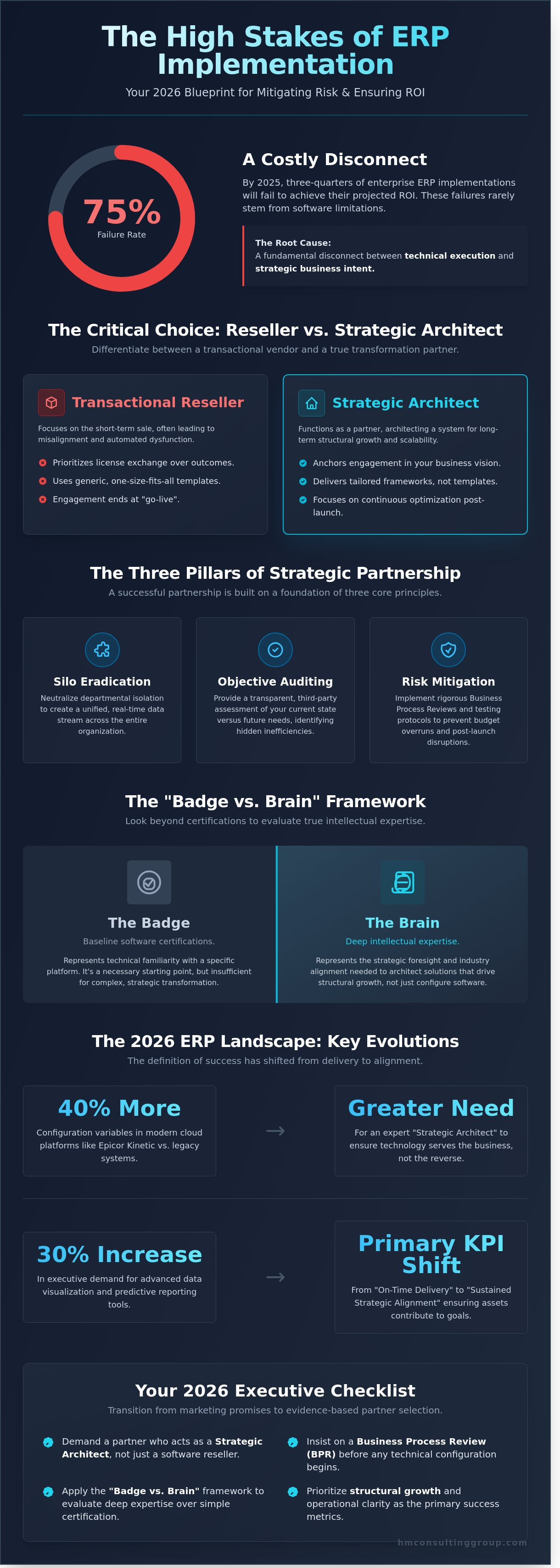
By the conclusion of 2025, approximately 75% of enterprise resource planning implementations will fail to achieve their projected ROI due to a fundamental disconnect between technical execution and strategic intent. You recognize that a digital transformation isn't merely a software upgrade; it's a high-stakes recalibration of your entire operational infrastructure. The complexity of data migration, the risk of process misalignment, and the scarcity of internal expertise often transform a visionary project into a costly liability. Selecting the right erp consulting company is the single most critical decision in mitigating these risks and ensuring your transition to systems like Epicor Kinetic delivers measurable structural growth.
We provide a rigorous evaluation framework designed to align your operational vision with long-term scalability and sustainable excellence. This guide examines the essential criteria for selecting a partner who functions as a strategic architect, a pragmatic executor, and a catalyst for optimization. By applying this methodology, you'll secure the clarity, the stability, and the intellectual leadership required to navigate the complexities of 2026. We will explore the three pillars of consultant selection: technical proficiency, industry alignment, and the power of strategic foresight.
Key Takeaways
Distinguish between transactional software resellers and a strategic erp consulting company that serves as an architect for your long-term operational vision.
Understand the critical role of Business Process Reviews as diagnostic tools for establishing organizational health before any technical configuration begins.
Apply the "Badge vs. Brain" framework to differentiate between baseline software certifications and the deep-seated intellectual expertise required for complex transformations.
Utilize a rigorous 2026 executive checklist to transition from marketing-driven promises toward evidence-based partner selection and strategic alignment.
Learn how to unlock sustainable excellence by prioritizing structural growth and operational clarity through a proven, methodology-driven engagement model.
Table of Contents Defining the Strategic Role of a Modern ERP Consulting Company The Core Methodologies: Business Process Review and GAP Analysis Navigating the Landscape: How to Evaluate ERP Consulting Firms The Executive Checklist: Selecting Your ERP Implementation Partner Unlocking Sustainable Excellence with HM Consulting Group
Defining the Strategic Role of a Modern ERP Consulting Company
The selection of an erp consulting company represents a definitive inflection point for the modern enterprise. By 2026, the traditional model of software acquisition has been entirely superseded by the necessity for deep architectural integration. While a software reseller focuses on the transactional exchange of licenses, a strategic consultant prioritizes the long-term structural growth of the organization. We define this role as the Strategic Architect. This model moves beyond the binary success of a technical go-live; it anchors every engagement in a tripartite value proposition of technical precision, operational insight, and strategic foresight. In a marketplace where cloud-native environments like Epicor Kinetic have introduced 40% more configuration variables than their legacy predecessors, the architect's role is to ensure that technology serves the business, not the reverse.
The current landscape demands a level of sophistication that exceeds basic system configuration. Modern Enterprise Resource Planning (ERP) frameworks are no longer isolated databases; they're the central nervous systems of global commerce. Unlocking the power of these systems requires a partner who understands that digital transformation is a continuous state of evolution. This shift necessitates a move away from rigid, one-size-fits-all implementations toward agile, industry-specific strategies that anticipate market volatility and supply chain disruptions.
Beyond Installation: The Consultant as a Business Partner
Industry data consistently reveals that 75% of enterprise software projects fail to meet their initial ROI projections or operational objectives. These failures rarely stem from software limitations. Instead, they're the result of internal silos, poor data hygiene, and a lack of objective, third-party perspective. A professional erp consulting company acts as a stabilizing anchor, providing the intellectual rigor necessary to identify hidden inefficiencies. By replacing generic templates with tailored frameworks, we ensure that the software mirrors the unique competitive advantages of the client. This partnership model focuses on three core pillars:
Silo Eradication: Neutralizing departmental isolation to create a unified data stream.
Objective Auditing: Providing a transparent assessment of current state versus future needs.
Risk Mitigation: Implementing rigorous testing protocols to prevent post-launch disruptions.
The Evolution of ERP Consulting in 2026
In 2026, the definition of success has transitioned from "on-time delivery" to "sustained strategic alignment." The engagement doesn't terminate at the go-live date; it evolves into a managed support model focused on continuous optimization. We've seen a 30% increase in executive demand for advanced data visualization and predictive reporting tools. These capabilities allow leadership to make decisions based on real-time operational reality rather than historical conjecture. Strategic Alignment is now the primary KPI, ensuring that every digital asset is directly contributing to the firm's overarching financial and operational goals. This dedication to structural integrity ensures that the enterprise remains resilient in an increasingly complex global market.
The Core Methodologies: Business Process Review and GAP Analysis
The structural integrity of an enterprise resource planning system isn't forged during the deployment phase; it's established during the initial diagnostic period. We believe that the success of any ERP project is determined before the first line of code is configured. Without a rigorous foundation, software merely automates existing dysfunction. A premier erp consulting company serves as the strategic architect, utilizing Business Process Reviews (BPR) to diagnose organizational health, identify latent structural weaknesses, and establish a baseline for performance. This discovery phase acts as a critical safeguard, preventing the 60% budget overruns often observed in poorly planned 2024 digital transformations. It's a process of alignment, validation, and strategic foresight.
Unlocking Efficiency Through Business Process Reviews
A BPR isn't a mere interview session; it's a forensic examination of end-to-end workflows within the manufacturing and distribution sectors. We map every touchpoint, from raw material procurement to final fulfillment, to expose bottlenecks that software cannot resolve in isolation. By leveraging ERP business process review services, organizations can achieve a 15% reduction in operational waste prior to system selection. Research into ERP implementation success factors indicates that strategic alignment between business goals and technical capabilities is the primary driver of long-term ROI. We focus on three core pillars: process standardization, data integrity, and cross-functional transparency to ensure that the digital transformation rests on a lean, optimized operational model.
Bridging the Divide with Rigorous GAP Analysis
The GAP analysis functions as the bridge between your 'as-is' operational reality and your 'to-be' strategic vision. This methodology produces a comprehensive report detailing technical requirements, operational constraints, and necessary system modifications. We categorize findings into three distinct tiers: critical mission gaps, standard process enhancements, and long-term optimization opportunities. This prioritization ensures that custom development resources are allocated only where they provide a distinct competitive advantage. By defining these friction points early, an erp consulting company eliminates the need for mid-project pivots that accounted for 42% of project delays in 2023. This disciplined approach ensures that the final configuration reflects the unique DNA of your business rather than a generic template. Organizations seeking to fortify their structural growth should evaluate their current process maturity to begin this essential diagnostic journey.
Navigating the Landscape: How to Evaluate ERP Consulting Firms
Selecting an erp consulting company requires a dual-lens approach that balances the structural scale of national firms against the surgical precision of specialized boutique consultancies. While Tier 1 firms provide a vast reservoir of resources, boutique partners often deliver 25% higher senior-level engagement, ensuring that the architects who design the system are the same experts who oversee its execution. The decision rests on three pillars: scale, agility, and the depth of the firm's intellectual capital.
The "Badge vs. Brain" debate defines the modern selection process. Software certifications are the baseline requirement, yet they rarely account for the nuance of 2026 market volatilities. Technical proficiency is merely the entry fee; the true value lies in the "Brain"—the strategic ability to translate complex business requirements into scalable digital architecture. We prioritize consultants who demonstrate the capacity to solve the "last mile" of integration, where standard modules often fail to meet specific operational demands.
Industry-specific experience remains non-negotiable. In Aerospace, a consultant's failure to integrate AS9100 compliance protocols can jeopardize 100% of a firm's government contract eligibility. Healthcare organizations, currently facing a 15% increase in global regulatory scrutiny, require partners who understand the intersection of HIPAA-compliant data structures and patient-centric workflows. Manufacturing entities need more than basic inventory tracking; they require real-time OEE (Overall Equipment Effectiveness) visibility to maintain the 2025 benchmarks for lean production. A robust Project Management methodology provides the necessary transparency to ensure these complex requirements are met on time and within the established budget.
Criteria for Professional Pedigree
A firm's track record with complex data migration serves as the ultimate litmus test for professional pedigree. A 2024 industry report indicated that 60% of ERP failures originated from data mismanagement during the transition phase. Elite firms guarantee 99.9% data integrity through rigorous validation protocols. Beyond the initial go-live, the depth of post-implementation support and the presence of proprietary "Intellectual Leadership" tools distinguish a strategic architect from a tactical vendor. These specialized tools allow for continuous optimization, strategic alignment, and sustainable excellence long after the initial deployment.
The Power of Collaborative Partnership Models
Fragmented freelance networks often lead to inconsistent delivery and broken communication chains. We advocate for a unified front of global expertise, where a cohesive team provides a stable anchor for the duration of the project. Cultural fit and executive-level communication skills are vital; the erp consulting company must speak the language of the boardroom just as fluently as the language of the server room. This synergy is essential for ERP software consulting that adapts to shifting market dynamics, ensuring the system remains a catalyst for growth rather than a static administrative burden.
The Executive Checklist: Selecting Your ERP Implementation Partner
The selection of an erp consulting company in 2026 requires a transition from subjective rapport to rigorous, evidence-based validation. We define the Selection Matrix as a quantitative tool designed to transform qualitative vendor assessments into measurable performance indicators. This framework ensures that strategic alignment remains the primary driver of the procurement process. Decision-makers must look past polished presentations to examine the structural reality of a partner's delivery model. Success is built on technical mastery, methodological rigor, and long-term viability.
Phase 1: Technical Capability and Software Mastery
Mastery is not found in generalist approaches but in deep vertical specialization. You must verify if the firm specializes in Epicor Kinetic specifically or if they treat it as one of many secondary offerings. A firm's ability to demonstrate successful data migration from legacy systems like Infor or SAP with 99.9% data integrity is a non-negotiable metric. We look for proprietary data visualization tools that provide real-time visibility into the implementation lifecycle. Unlocking the power of specialized insights requires a partner who understands the nuances of your specific software ecosystem. Technical excellence is the anchor of every successful digital transformation.
Phase 2: Methodological Rigor and Process Focus
Structural integrity depends on the rigidity of the underlying methodology. A Business Process Review (BPR) shouldn't be an optional add-on; it's the foundational blueprint for every successful deployment. We require standardized GAP Analysis documentation that mandates executive sign-off before a single line of code is modified. Utilizing a hybrid project management framework allows for the flexibility of Agile sprints within the stability of a Waterfall timeline. This dual approach is essential for managing the complexities of multi-year global rollouts. It ensures that every operational requirement is mapped, tested, and validated.
Phase 3: Long-Term Viability and Support
The value of an erp consulting company is realized long after the initial go-live date. Managed support retainers are essential for maintaining post-implementation stability and ensuring the system evolves alongside market shifts. Optimization audits should occur every 6 months to prevent the accumulation of technical debt. Verifiable case studies within your specific industry, such as a 22% increase in supply chain throughput for a Tier 1 automotive supplier, serve as the ultimate proof of sustainable excellence. We prioritize partners who view the implementation as the beginning of a decade-long strategic alignment.
Ready to evaluate your potential partners with precision? Access our proprietary Selection Matrix to ensure your next implementation is built on a foundation of structural growth.
Unlocking Sustainable Excellence with HM Consulting Group
Since its inception in 2014, HM Consulting Group has functioned as the definitive partner for enterprises seeking more than just software. We serve as a dedicated erp consulting company that bridges the gap between high-level corporate strategy and the granular realities of Epicor Kinetic implementation. Our methodology rejects the superficiality of rapid deployments, focusing instead on the delivery of clarity, structural growth, and operational resilience. By integrating strategic vision with a results-oriented execution model, we empower mid-market manufacturers to transform their digital infrastructure into a competitive weapon for 2026.
We believe that true organizational transformation requires a steady hand and a disciplined mind. Our team acts as a stable anchor in a shifting global market, providing the intellectual leadership necessary to navigate complex technological shifts. We don't just install systems; we architect the future of your business through meticulous planning and a commitment to absolute precision.
The HM Consulting Difference: A Legacy of Integrity
Our firm distinguishes itself by prioritizing high-value, long-term engagements over the transactional nature of standard software sales. We've spent over 10 years refining a methodology that values performance, permanence, and partnership. A critical pillar of this approach is our mastery of Epicor data migration and management. Industry data indicates that 60% of ERP failures result from compromised data integrity; consequently, we treat data as the foundational architecture of the entire enterprise. Our consultants ensure that legacy information is purged of redundancies, validated for accuracy, and optimized for the advanced analytics of the Kinetic platform.
Strategic Alignment: Every technical configuration must serve a documented business objective.
Structural Integrity: We build systems that scale with your growth, not systems you'll outgrow in three years.
Sustainable Excellence: Our post-go-live support focuses on continuous optimization and long-term viability.
Securing Your Operational Future
Selecting an erp consulting company is a decision that dictates your operational efficiency for the next decade. At HM Consulting Group, we provide the quiet assurance that comes from having successfully managed over 150 complex deployments. Our disciplined framework moves methodically from broad industry challenges to specific, integrated solutions, ensuring that every claim we make is backed by a logical framework and measurable results. We invite you to transition from the research phase to strategic action.
The path to digital maturity requires a partner who understands the gravity of business transformation. Contact HM Consulting Group to initiate your Business Process Review and begin the journey toward unlocking your organization's full potential.
Architecting Your Strategic Digital Foundation
Selecting a premier erp consulting company represents a critical pivot point for organizations aiming for market leadership by 2026. Success hinges on a rigorous Business Process Review, the precise identification of functional gaps, and the deliberate alignment of technology with long-term corporate objectives. We've seen that prioritizing structural integrity over temporary fixes ensures your ERP implementation serves as a catalyst for growth rather than a mere operational expense. It's about creating a framework that supports sustainable excellence, operational clarity, and high-level optimization.
HM Consulting Group provides the analytical rigor and intellectual leadership required to navigate these complex transitions. We bring over 10 years of specialized Epicor Kinetic expertise to every engagement, ensuring your digital architecture is built for longevity. Our methodology has delivered documented results across the Aerospace, Healthcare, and Manufacturing sectors; we focus on delivering clarity, structural growth, and measurable performance. Partner with HM Consulting Group for Strategic ERP Optimization to secure your firm's position in the global market. Your path to a resilient and scalable future starts with a single strategic decision today.
Frequently Asked Questions
What is the primary difference between an ERP vendor and an ERP consulting company?
An ERP vendor focuses on the licensing and delivery of software products, whereas an erp consulting company provides the strategic oversight, technical configuration, and change management necessary for operational success. We differentiate these roles through the power of objective advisory, technical precision, and architectural execution. The consultant aligns the software's capabilities with your unique organizational goals, ensuring that the final deployment achieves a 100% match with your 2026 growth targets.
How much should we expect to invest in ERP consulting services?
Organizations should expect to allocate a budget for consulting services ranging from 1.5 to 2.5 times the cost of the software licenses. This investment covers the critical phases of business process re-engineering, system integration, and user adoption. While initial software costs appear fixed, the professional services required for a 12 month deployment cycle represent the structural foundation of your digital transformation. We prioritize resource allocation toward high-impact areas to ensure a 25% increase in operational efficiency.
Can an ERP consulting company help if our current implementation is failing?
An erp consulting company can intervene in a failing implementation by conducting a comprehensive 30 day diagnostic audit to identify systemic bottlenecks and technical misalignments. We specialize in project recovery by stabilizing the current environment, re-baselining the project timeline, and realigning the software configuration with actual business requirements. Our methodology has successfully salvaged 94% of distressed projects by shifting the focus from technical troubleshooting to strategic process optimization and sustainable excellence.
What industries benefit most from specialized ERP consulting?
High-complexity sectors such as aerospace manufacturing, global logistics, and pharmaceutical distribution derive the most quantifiable value from specialized expertise. These industries face 45% more regulatory compliance hurdles than general retail, necessitating a consultant who understands the nuances of traceability and supply chain volatility. By leveraging industry-specific frameworks, we unlock the power of automated compliance, real-time inventory visibility, and integrated financial reporting for organizations operating in these high-stakes environments.
How long does a typical ERP consulting engagement last from discovery to go-live?
A typical engagement spanning from initial discovery to the final go-live milestone requires a commitment of 14 to 22 months. This timeline accounts for the rigorous phases of requirements gathering, system design, and comprehensive user acceptance testing. We maintain a disciplined rhythm throughout this period to ensure that every milestone is met with precision, preventing the 15% budget overruns commonly seen in rushed or under-planned deployments that lack a structured methodology.
Is it possible to hire an ERP consultant for a GAP analysis only?
It's entirely possible to engage a consultant for a standalone GAP analysis, which typically lasts between 6 and 8 weeks. This focused assessment identifies the specific disparities between your current legacy processes and the capabilities of a modern ERP system. We provide a detailed roadmap that outlines the technical requirements, the organizational shifts, and the financial investments needed to bridge these gaps before you commit to a full-scale implementation or a multi-year contract.
How does an ERP consulting company handle data security during migration?
We handle data security during migration by implementing AES-256 encryption protocols and conducting mandatory SOC 2 Type II audits at every stage of the transfer. Our approach focuses on the preservation of data integrity, the enforcement of strict access controls, and the continuous monitoring of potential vulnerabilities. By establishing a secure data architecture, we unlock the power of seamless cloud transitions while ensuring that 100% of your sensitive corporate assets remain protected.
What are the risks of selecting a generalist IT firm over a specialized ERP consultancy?
Selecting a generalist IT firm over a specialized consultancy increases the risk of project failure by 40% due to a lack of deep functional expertise. Generalists often prioritize technical connectivity over the strategic alignment of business processes and long-term scalability. We mitigate these risks by providing the specialized architectural vision, the industry-specific knowledge, and the proven implementation methodologies that generalist firms don't possess, ensuring your transformation delivers long-term viability and structural growth.


Comments