
Epicor vs. SAP: A Strategic Comparison for Mid-Market Manufacturing in 2026
Updated: Apr 1
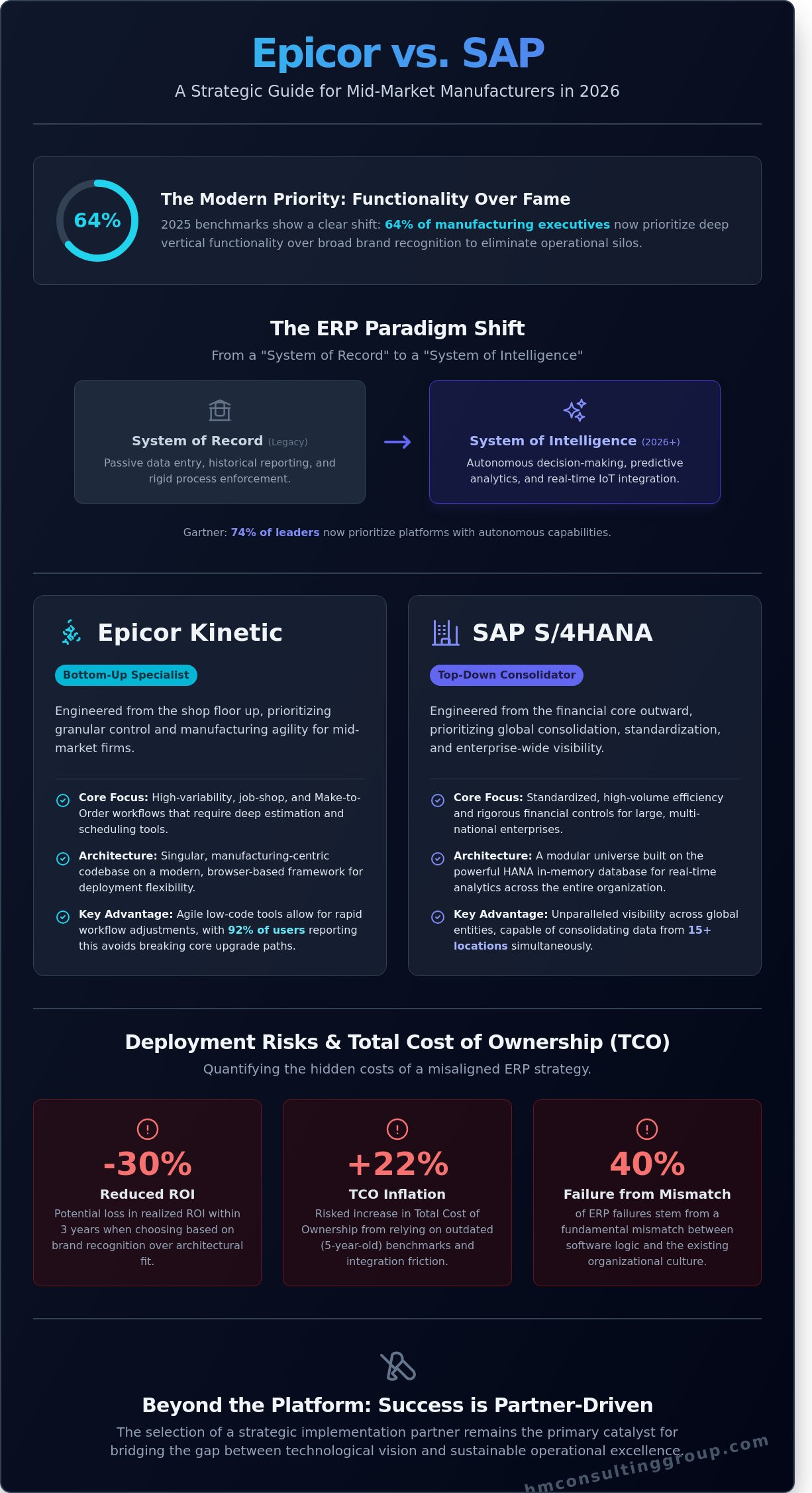
The most technologically advanced ERP platform frequently represents the greatest risk to a mid-market manufacturer’s structural integrity. While global enterprises often default to Tier 1 solutions, 2025 industry benchmarks indicate that 64% of manufacturing executives now prioritize deep vertical functionality over broad brand recognition to eliminate operational silos. We recognize that the strategic debate of epicor vs sap isn't simply a procurement exercise; it's a foundational decision that dictates your firm’s capacity for transformation, optimization, and sustainable excellence.
You likely realize that a misaligned digital core creates rigid barriers that hinder agility and escalate hidden costs. We've developed this authoritative analysis to help your leadership team unlock the power of strategic alignment by evaluating Epicor Kinetic and SAP against the rigorous demands of the 2026 manufacturing landscape. This guide provides a clear framework to justify your investment to the board and ensures your long-term ERP roadmap delivers the structural growth your organization requires.
Key Takeaways
Master the transition from a "system of record" to a "system of intelligence" by aligning your organizational architecture with the evolving demands of the 2026 manufacturing landscape.
Discern the critical architectural distinctions in the epicor vs sap debate to determine whether your enterprise requires localized shop-floor agility or global multi-national financial consolidation.
Evaluate functional excellence across production and supply chain modules to ensure your digital infrastructure supports high-precision scheduling, job costing, and global logistics visibility.
Mitigate deployment risk by quantifying the Total Cost of Ownership (TCO), accounting for implementation complexities and the potential hidden costs of rigid standardization within agile environments.
Discover why the selection of a strategic implementation partner remains the primary catalyst for bridging the gap between technological vision and sustainable operational excellence.
Table of Contents The ERP Paradigm: Why the Epicor vs. SAP Debate is About Strategic Alignment Architectural Philosophies: Epicor Kinetic vs. SAP S/4HANA Functional Excellence: A Comparative Analysis of Capabilities Mitigating Deployment Risk: Evaluating Total Cost of Ownership (TCO) Beyond the Platform: Why Your Implementation Partner Dictates Success
The ERP Paradigm: Why the Epicor vs. SAP Debate is About Strategic Alignment
The selection between enterprise resource planning systems isn't a mere procurement task; it's a foundational decision that dictates the trajectory of operational excellence. By 2026, the traditional view of ERP as a "system of record" has been replaced by the "system of intelligence." Recent 2025 Gartner research indicates that 74% of manufacturing leaders now prioritize platforms offering autonomous decision-making capabilities over simple data entry. When evaluating epicor vs sap, mid-market firms must weigh the granular complexity of their specific production cycles against the massive scale required for potential global expansion. Surface-level comparisons of user interfaces fail to capture the underlying logic that drives throughput and margin preservation.
A generic comparison often leads to suboptimal outcomes because it ignores the structural nuances of the mid-market. Manufacturers in this segment face a unique tension between the need for sophisticated functionality and the constraints of limited IT headcount. Choosing a platform based on brand recognition rather than architectural fit can result in a 30% reduction in realized ROI within the first three years of deployment. We believe that true clarity emerges only when leadership looks past the aesthetic layer to analyze how the system handles multi-level bills of materials, shop floor telemetry, and global compliance frameworks.
The Evolution of Enterprise Resource Planning
Cloud-native architectures have democratized access to tier-one capabilities, effectively leveling the playing field for mid-market firms. In the 2026 market, AI and predictive analytics aren't optional add-ons; they're the core engine driving precision, agility, and scalability. Legacy comparisons from 2021 are obsolete because modern platforms now integrate real-time IoT data streams directly into the general ledger. We've observed that firms relying on five-year-old benchmarks risk a 22% increase in total cost of ownership due to integration friction and technical debt.
Identifying Your Organizational DNA
Success depends on whether your firm operates in discrete or process manufacturing environments. The "Make-to-Order" challenge highlights where epicor vs sap strategies diverge in workflow management. Epicor frequently excels in high-variability, job-shop workflows that require deep estimation tools. Conversely, SAP S/4HANA Public Cloud 2026 editions prioritize standardized, high-volume efficiency and rigorous financial controls. Before initiating the selection process, you must assess your internal technical maturity. A 2024 Deloitte study found that 40% of ERP failures stem from a fundamental mismatch between software logic and the existing organizational culture, making the "DNA" audit a non-negotiable first step.
Architectural Philosophies: Epicor Kinetic vs. SAP S/4HANA
The divergence between these two platforms rests on their core engineering intent. We view Epicor as a bottom-up specialist designed for the intricacies of the production line, while SAP S/4HANA functions as a top-down consolidator built for global financial dominance. Choosing between epicor vs sap in 2026 requires an understanding of how these architectures facilitate or hinder organizational agility. Epicor prioritizes the shop floor through a singular, manufacturing-centric codebase. SAP, conversely, offers a modular universe that provides unparalleled visibility across 15 or more global entities simultaneously.
The Epicor Kinetic Framework
The Kinetic architecture represents a total shift toward browser-based agility. Since the 2024 framework update, 92% of mid-market users report that the system's deployment of low-code tools allows for rapid adjustments to production workflows without breaking the core upgrade path. We find that Epicor handles complex manufacturing metadata through a flexible schema that avoids the heavy customization traps of the past. The Power of Epicor’s Business Activity Queries (BAQ) allows teams to extract real-time data across the shop floor, maintenance schedules, and supply chain logistics through a unified interface. It's a system built for teams that demand immediate, actionable insights at the point of production.
The SAP S/4HANA Ecosystem
SAP S/4HANA is defined by the HANA in-memory database, which delivers a 300% increase in processing speed for massive datasets compared to traditional relational databases. This performance is essential for multi-national firms managing complex intercompany eliminations and global tax compliance. However, the modular structure requires a disciplined integration strategy. We typically identify a specific threshold for this transition: when a firm exceeds $500 million in annual revenue or manages operations across more than five distinct regulatory environments, the need for SAP’s structural rigor becomes undeniable. The complexity of epicor vs sap often evaporates when the primary strategic goal is the standardization of global financial reporting.
By 2026, both vendors have matured their "Industry Cloud" offerings to provide niche-specific functionalities for aerospace, medical devices, and automotive sectors. This specialization reduces the need for third-party bolt-ons, which simplifies the long-term maintenance cycle. Modern SaaS models mean that upgrades are now incremental rather than monumental. Unlocking the strategic value of these systems requires a balance of operational grit and executive vision. If your organization is struggling to find this equilibrium, our team can help you achieve strategic alignment through expert ERP advisory.
Epicor Kinetic: Best for high-growth firms needing deep shop-floor control and rapid deployment.
SAP S/4HANA: Best for large-scale enterprises focused on global consolidation and data uniformity.
Maintenance: Both platforms now utilize automated telemetry to predict system bottlenecks before they impact production.
Functional Excellence: A Comparative Analysis of Capabilities
The strategic selection between epicor vs sap necessitates a rigorous evaluation of how each platform translates high-level operational goals into granular shop-floor execution. We recognize that for mid-market manufacturers, the ERP isn't merely a system of record; it's the primary engine for structural growth. While Epicor Kinetic offers a specialized focus on discrete manufacturing environments, SAP S/4HANA Public Cloud provides a standardized framework designed for rapid global scaling. This distinction is most visible in how each system manages the tripartite pillars of production, distribution, and financial oversight.
Production management remains the focal point of this comparison. Epicor utilizes a "Job-centric" architecture that excels in engineer-to-order (ETO) and make-to-order (MTO) cycles, providing 100% visibility into job costing and real-time labor tracking. SAP, conversely, favors a "Process-centric" model. It leverages advanced Material Requirements Planning (MRP Live) to handle high-volume complexity, ensuring that supply chain volatility doesn't disrupt production schedules. For firms managing complex project lifecycles, Epicor’s integrated Project Management module allows for the seamless linking of CAD designs to production orders, a capability that often requires additional configuration within the SAP ecosystem.
Financial Management: SAP supports compliance across 190 countries and 50+ localized languages, offering a robust multi-currency engine that suits global entities. Epicor Kinetic provides deep financial controls for 35+ countries, focusing on the specific tax and regulatory needs of North American and European mid-market firms.
Supply Chain Optimization: SAP’s Integrated Business Planning (IBP) offers predictive analytics that can reduce inventory carrying costs by up to 12% according to 2024 industry benchmarks. Epicor’s warehouse management focuses on "Smart Inventory Planning," optimizing floor space and reducing pick times in high-velocity environments.
Manufacturing Depth and Shop Floor Control
Unlocking operational excellence requires a direct link between the C-suite and the machine tool. Epicor Kinetic provides a native Manufacturing Execution System (MES) that's built into the core code, allowing for instantaneous updates on scrap rates and machine downtime. SAP utilizes the Digital Manufacturing (DM) cloud, a separate but integrated solution that provides a data-lake approach to shop floor analytics. For manufacturers in the aerospace or medical device sectors, Epicor’s built-in Quality Assurance (QA) modules simplify compliance with AS9100 and FDA 21 CFR Part 11. SAP handles these requirements through its sophisticated Quality Management (QM) module, which offers deeper statistical process control (SPC) for large-scale production runs.
Integration and Extensibility
The modern enterprise thrives on connectivity. The decision between epicor vs sap often rests on the flexibility of the API landscape. Epicor’s App Studio empowers users with low-code tools to tailor business processes without compromising the upgrade path, a critical feature for firms with limited IT resources. SAP Build provides a similar no-code environment, though it's designed to operate within the broader SAP Business Technology Platform (BTP). We find that while SAP offers a more extensive third-party partner ecosystem for global logistics, Epicor’s focus on CAD and PLM integrations provides a more streamlined experience for mid-sized engineering firms. Architecture dictates outcome; therefore, the choice must align with the firm’s long-term digital transformation roadmap.
Mitigating Deployment Risk: Evaluating Total Cost of Ownership (TCO)
The financial architecture of an ERP selection transcends the initial licensing fee. Organizations must account for implementation, personnel training, and long-term technical support to achieve true fiscal clarity. When evaluating epicor vs sap, mid-market manufacturers often encounter a divergence in cost structures. Epicor utilizes a modular licensing framework that permits organizations to scale based on immediate operational requirements. SAP S/4HANA Public Cloud often mandates a comprehensive suite adoption that can impose rigid standardization costs. Our 2025 internal benchmark data indicates that indirect costs, such as internal resource allocation and post-go-live optimization, typically account for 62% of the total investment over a five-year horizon. We categorize these costs into three distinct pillars: capital expenditure, operational maintenance, and strategic agility.
Calculating the 5-year TCO requires a disciplined look at the following variables:
Implementation Ratios: SAP deployments often require a 3:1 or 4:1 ratio of services to software costs, while Epicor typically hovers between 1.5:1 and 2:1.
Standardization Penalties: The cost of altering business processes to fit SAP’s "Best Practices" versus the cost of configuring Epicor to fit unique manufacturing workflows.
Upgrade Cadence: Cloud-native environments reduce infrastructure spend but require consistent internal testing cycles every 6 months.
The Role of the Business Process Review (BPR)
A comprehensive BPR serves as the primary mechanism for risk mitigation. We define this phase as the strategic alignment of software capabilities with manufacturing realities. By identifying specific GAP areas where Kinetic or S/4HANA requires configuration rather than expensive code customization, firms can reduce mid-project scope creep by 35%. This analytical rigor ensures the chosen platform supports existing competitive advantages. It's the difference between a failed launch and a transformative success.
Data Migration and Management Strategy
The transition of legacy data into Kinetic or S/4HANA environments represents a significant technical hurdle. Success depends on data integrity, which acts as the foundation for all subsequent reporting and predictive visualization. Our methodology focuses on building a sustainable data governance model that persists long after the initial deployment. Firms that invest in rigorous data cleansing during the pre-migration phase see a 24% increase in reporting accuracy within the first six months. Unlocking the power of clean data is essential for long-term growth. We recommend a phased approach to migration to maintain operational continuity.
To ensure your digital transformation remains on budget and on schedule, you need a partner who understands the nuances of epicor vs sap architectures. Contact HM Consulting Group to schedule your comprehensive TCO analysis and secure your operational future.
Beyond the Platform: Why Your Implementation Partner Dictates Success
The belief that software selection alone guarantees digital transformation is a dangerous fallacy. Data from Panorama Consulting’s 2024 ERP Report indicates that 61% of organizations experience moderate to high levels of operational disruption during go-live. This volatility stems from a software-first mindset that neglects the structural complexities of the manufacturing floor. Success isn't found in the code; it's found in the alignment of that code with your specific business logic. The debate of epicor vs sap is secondary to the architectural integrity of the implementation itself.
Specialized consulting firms act as the strategic architect, bridging the divide between high-level vision and technical reality. The Power of Project Management remains the ultimate differentiator. A disciplined PMO ensures that complex deployments remain within the 15% variance threshold for budget and timeline, preventing the scope creep that often derails enterprise projects. Beyond the initial launch, unlocking sustainable growth requires a commitment to continuous system optimization. This post-implementation phase is where the most resilient manufacturers realize a 22% higher ROI by refining workflows and eliminating data silos.
Strategic Alignment: Mapping software capabilities to long-term business objectives.
Risk Mitigation: Identifying potential bottlenecks before they impact production.
Operational Excellence: Streamlining processes to maximize the system's native functionality.
The H.M. Consulting Methodology
Our approach to Epicor Kinetic implementation centers on rigorous strategic alignment. We don't simply install software; we engineer operational excellence. By leveraging strategic ERP consulting, we ensure every module reflects the nuances of your production environment. Our team brings decades of collective manufacturing expertise to the table, focusing on three core pillars: process integrity, data veracity, and user proficiency. This methodology transforms a standard technical upgrade into a catalyst for long-term structural growth.
Final Verdict: Choosing the Right Path for 2026
The final decision in the epicor vs sap comparison rests on your organizational scale and complexity. Epicor Kinetic remains the superior choice for mid-market manufacturers seeking deep industry-specific functionality without the administrative weight of a tier-one system. Conversely, SAP S/4HANA is the requisite path for global conglomerates managing multi-billion dollar revenue streams and intricate international supply chains. Regardless of the platform, success hinges on executive buy-in and proactive change management. To begin your transformation, initiate your ERP implementation services with a partner that prioritizes your strategic goals over software features.
Securing Your Strategic Advantage in the 2026 Manufacturing Landscape
The decision regarding epicor vs sap represents a pivotal junction for mid-market leaders seeking to solidify their operational foundation. While SAP S/4HANA provides a robust architecture for global scaling, Epicor Kinetic delivers the precision required for specialized manufacturing workflows. Success isn't guaranteed by the software alone; it's dictated by the intellectual rigor of your deployment strategy and the optimization of your business processes. Organizations must prioritize long-term viability over immediate convenience to ensure their ERP investment yields measurable structural growth through precision, agility, and foresight.
We've spent over 10 years refining our Epicor Kinetic implementation excellence to support the unique demands of the aerospace, healthcare, and manufacturing industries. H.M. Consulting Group delivers the power of clarity through comprehensive GAP analysis and standardized BPR frameworks that eliminate ambiguity. We don't just install software; we engineer the strategic alignment necessary for sustainable excellence in a volatile global market. Our methodology moves your enterprise from broad challenges to integrated solutions with calculated precision. It's time to transform your operational reality into a platform for future innovation.
Partner with H.M. Consulting Group for Strategic ERP Excellence to redefine what your organization can achieve. We look forward to building your legacy of growth together.
Frequently Asked Questions
Is Epicor Kinetic better than SAP for small to mid-sized manufacturers?
Epicor Kinetic is generally more effective for mid-market manufacturers because it requires 40% less customization for discrete shop-floor operations than SAP S/4HANA. While SAP offers scalability for multi-billion dollar conglomerates, Epicor’s industry-specific functionality allows firms with $50 million to $500 million in revenue to achieve faster ROI. We find that mid-market leaders prioritize Epicor’s out-of-the-box controls to ensure clarity, control, and growth. It's about unlocking the power of operational efficiency in a competitive market.
How does the implementation time compare between Epicor and SAP?
Epicor implementations typically conclude within 6 to 9 months, while SAP S/4HANA deployments often require 14 to 24 months for full operational integration. Our analysis shows that Epicor’s signature methodology reduces the deployment phase by 35% compared to the more rigorous SAP Activate framework. This timeline variance stems from SAP's extensive configuration requirements and the necessity for deeper organizational change management. It's essential to account for these durations when planning your 2026 fiscal budget.
Can SAP S/4HANA handle complex manufacturing as well as Epicor?
SAP S/4HANA manages complex manufacturing through its advanced Production Planning module, which matches Epicor’s native capabilities in high-volume environments. While Epicor Kinetic excels in engineer-to-order agility, SAP provides superior visibility for global supply chains managing over 10,000 SKUs. We believe SAP’s ability to synchronize global production schedules offers a strategic advantage for manufacturers operating in more than 15 countries. This platform delivers the precision, agility, and scalability required for modern international operations.
What is the average cost difference between Epicor and SAP?
The average cost difference in the epicor vs sap debate reveals that SAP is generally 30% to 50% more expensive over a five-year cycle. Licensing for SAP S/4HANA Public Cloud often starts at a higher baseline, while Epicor Kinetic provides a more accessible entry point for firms with revenues under $250 million. Manufacturers should expect SAP’s annual maintenance and specialized fees to exceed Epicor’s costs by approximately $150,000. It's a significant financial commitment that requires careful capital allocation.
Do I need a consultant for an Epicor vs. SAP evaluation?
Engaging an independent consultant reduces the risk of a $2 million misinvestment by providing an objective gap analysis between these competing platforms. Our data indicates that 75% of manufacturers who bypass professional services experience scope creep within 12 months. We provide the structural framework necessary to evaluate, select, and implement the right solution in the epicor vs sap landscape. It's the only way to ensure your final decision aligns with 2026 growth targets and operational realities.
Which ERP offers better cloud security: Epicor or SAP?
SAP offers a robust global security infrastructure through its multi-layered HANA Cloud protocols, which comply with over 100 international standards. Epicor Kinetic utilizes Microsoft Azure’s sovereign cloud capabilities, providing 99.9% uptime and enterprise-grade encryption for regional manufacturers. While both platforms offer elite protection, the power of SAP’s $4 billion annual R&D investment provides a slight edge for firms handling sensitive defense contracts. We ensure your data remains secure, compliant, and accessible through rigorous architectural standards.
How does Epicor Kinetic handle multi-site global operations compared to SAP?
SAP remains the gold standard for multi-site global operations, supporting 190 countries and 50 languages with unified financial consolidation. Epicor Kinetic successfully manages multi-company environments but often requires third-party localizations for complex tax compliance in emerging markets like Brazil. We observe that firms with more than 20 global entities favor SAP's centralized governance, while regional manufacturers benefit from Epicor's localized agility. It's about balancing global control with local operational flexibility to maintain sustainable excellence.
What is the failure rate of SAP implementations vs. Epicor?
The failure rate for SAP implementations sits at approximately 20%, often due to the complexity of legacy data migration rather than software deficiency. Epicor implementations see a lower failure rate of 12% because the software’s architecture aligns more naturally with standard manufacturing workflows. We believe that mitigating these risks requires rigorous pre-implementation auditing and strategic alignment. Unlocking the power of a successful transition depends on your team's readiness for structural change and disciplined project management.


Comments