
ERP for Professional Services: A Strategic Framework for Operational Excellence
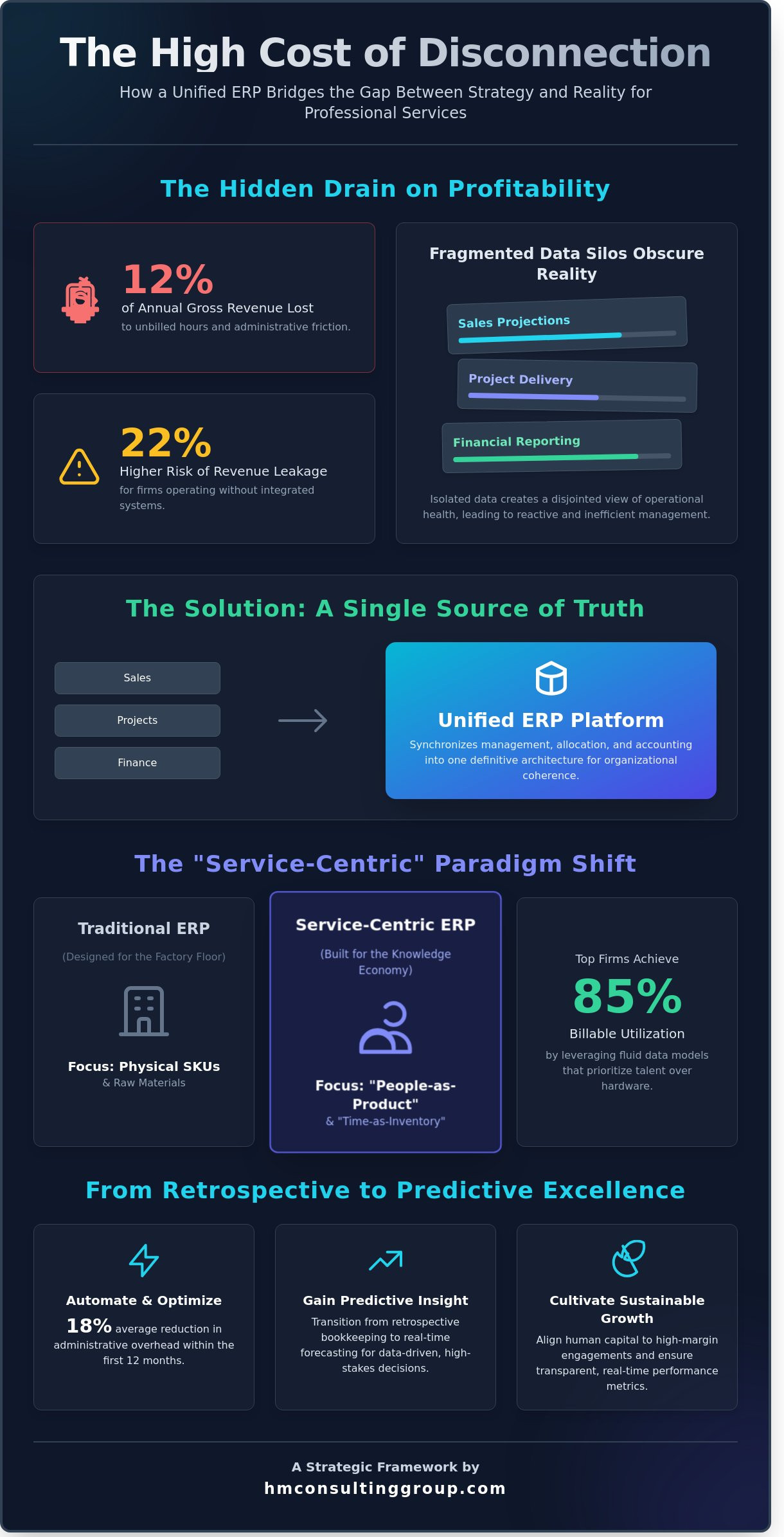
The erosion of 12% of annual gross revenue through unbilled hours and administrative friction isn't an inevitable cost of doing business; it's a failure of structural integration. You've likely felt the strain of data silos where sales projections, project delivery, and financial reporting exist in isolation, creating a fragmented view of your firm's operational health. We understand that maintaining real-time visibility into project margins is critical for any organization seeking to transition from reactive management to proactive optimization. It's time to bridge the gap between your strategic vision and your operational reality.
By implementing a sophisticated erp for professional services, you can unlock the power of unified data to drive sustainable excellence across every department. This guide provides a strategic framework to align your project profitability with structural scalability, ensuring your delivery teams and financial goals operate in perfect harmony. We'll examine how to establish a single source of truth, automate your resource forecasting for the 2024 fiscal year, and secure the strategic alignment necessary for long-term growth through intellectual leadership and disciplined execution.
Key Takeaways
Transition from traditional models to a service-centric paradigm that prioritizes "people-as-product" and optimizes "time-as-inventory" for enhanced operational clarity.
Identify the critical functional pillars of an effective erp for professional services, ensuring project delivery timelines remain strictly aligned with financial performance milestones.
Evaluate the long-term impact of the "integration tax" by comparing the structural integrity of unified enterprise platforms against fragmented, best-of-breed application stacks.
Follow a rigorous, phase-based roadmap involving Business Process Reviews and GAP analyses to bridge the divide between current capabilities and future-state excellence.
Unlock sustainable growth by combining the technical sophistication of Epicor Kinetic with the visionary guidance of a strategic architect to drive total business transformation.
Table of Contents Defining the Strategic Role of ERP for Professional Services Core Functional Pillars of a Professional Services ERP System Evaluating the Implementation Landscape: All-in-One vs. Integrated Suites A Strategic Roadmap for ERP Selection and Deployment Unlocking Sustainable Growth with Epicor Kinetic and Strategic Advisory
Defining the Strategic Role of ERP for Professional Services
We recognize that an Enterprise Resource Planning (ERP) system serves as the definitive architecture for organizational coherence. For firms operating within the knowledge economy, an erp for professional services isn't merely a back-office utility; it's a unified platform that synchronizes project management, resource allocation, and financial accounting into a single source of truth. By 2024, data from global industry benchmarks indicates that firms operating without integrated systems face a 22% higher risk of revenue leakage due to uncaptured billable hours and administrative friction. We view the deployment of these systems as the primary mechanism to dismantle the data silos that traditionally obscure the true cost of service delivery. Through this integration, we establish a foundation for structural growth, operational transparency, and long-term viability.
The Power of a unified data model lies in its ability to bridge the gap between high-level strategy and daily execution. When we implement these systems, we prioritize the integrity of the data stream to ensure that every billable minute is accounted for and every resource is optimized. This approach transforms the ERP from a cost center into a catalyst for sustainable excellence. It's a shift that moves the organization away from reactive management toward a model of disciplined, proactive oversight.
The "Service-Centric" Difference
Traditional ERP frameworks were designed for the factory floor, focusing on the movement of physical SKUs and raw materials. In contrast, an erp for professional services must account for "people-as-product" and "time-as-inventory." The shift is fundamental. We're no longer tracking linear supply chains; we're managing intellectual capital, fluctuating utilization rates, and non-linear project lifecycles. A 2023 study by SPI Research suggests that top-performing firms achieve 85% billable utilization by leveraging fluid data models that prioritize talent over hardware. This architectural shift ensures that strategic vision, operational reality, and financial outcomes remain in constant alignment.
Beyond Basic Accounting: The Maturity Model
Unlocking the potential of a professional services firm requires a transition from retrospective bookkeeping to predictive business intelligence. The maturity model we advocate for moves beyond simple ledger entries to real-time forecasting and automated workflows. When executive leadership accesses a centralized system of record, they gain the clarity needed for high-stakes, data-driven decisions. This transformation reduces administrative overhead by an average of 18% within the first 12 months of implementation. We facilitate this evolution by focusing on three core pillars:
Strategic alignment of human capital to high-margin engagements.
Optimization of revenue recognition through integrated project workflows.
Cultivation of sustainable excellence via transparent, real-time performance metrics.
This logical progression creates a sense of inevitability in firm growth. By replacing fragmented spreadsheets with a robust digital spine, we empower partners to focus on client delivery rather than data reconciliation. It's a calculated move toward a more sophisticated, resilient business model.
Core Functional Pillars of a Professional Services ERP System
A robust erp for professional services functions as the central nervous system of a firm; it integrates disparate data streams into a unified strategic vision. The architecture of these systems rests upon four critical pillars: integrated project management, resource optimization, financial transparency, and client relationship management. By aligning delivery timelines with financial milestones, firms transition from reactive firefighting to proactive steering. This structural alignment ensures that the sales pipeline doesn't outpace delivery capacity, maintaining the equilibrium between market demand and operational reality. Leading organizations recognize that they must prioritize their ERP foundation to sustain growth in volatile markets. Clarity, stability, and scalability represent the ultimate goals of this digital transformation.
The Power of Resource Demand Forecasting
Strategic resource management requires more than simple scheduling. It demands the intelligent application of historical data to predict future staffing requirements, preventing the twin risks of consultant burnout and under-utilization. We see firms achieve a 15% increase in billable utilization by leveraging predictive analytics to manage global talent pools across multiple jurisdictions. Unlocking latent capacity within the workforce requires a disciplined approach to data. This process involves the precise alignment of specialized skill sets with high-value engagements; it ensures that delivery quality remains consistent regardless of geographic complexity. Effective erp for professional services platforms allow leaders to visualize capacity gaps 180 days in advance, providing the clarity needed for informed hiring and training decisions.
Real-Time Project Profitability and Margin Analysis
Financial integrity depends on the automated recognition of revenue and the granular tracking of project-specific costs. Modern systems provide immediate visibility into Work-in-Progress (WIP) and project margins, identifying low-margin service lines before they erode annual profitability. By automating billing cycles, firms frequently reduce Days Sales Outstanding (DSO) from an industry average of 45 days to fewer than 32 days. This acceleration of cash flow provides the liquidity necessary for reinvestment and expansion. Professional services leaders who seek to optimize their financial frameworks often find that real-time data is the most effective tool for maintaining structural growth. Every direct and indirect cost is captured, ensuring that project managers are held accountable for the fiscal health of their engagements. This level of scrutiny fosters a culture of transformation, optimization, and sustainable excellence.
Evaluating the Implementation Landscape: All-in-One vs. Integrated Suites
The choice between a fragmented "best-of-breed" architecture and a unified erp for professional services platform represents a fundamental strategic fork in the road. While individual point solutions promise immediate agility, they often impose a 22% increase in administrative overhead due to the "integration tax." This tax manifests as the continuous capital and labor required to maintain API connections and reconcile disparate datasets across the enterprise. We believe that structural growth requires a cohesive digital foundation. A single source of truth eliminates the friction inherent in siloed environments; it ensures that financial, project, and talent data remain synchronized in real-time without the need for manual intervention.
This structural density allows leadership to move from a reactive posture to a proactive one. When data flows seamlessly from a centralized core, the risk of "version conflict" disappears. Organizations that prioritize an integrated suite over a collection of apps achieve a 18% higher margin on average by reducing the leakage associated with unbilled hours and misaligned resource allocation. This strategic alignment is the prerequisite for operational excellence.
The Hidden Cost of "Franken-stacks"
Managing a "Franken-stack" of disconnected tools introduces significant operational fragility. Manual data synchronization consumes approximately 15 hours per week for average project managers in firms with over 100 employees. These manual touchpoints increase the probability of data corruption by 30%, which directly impacts the accuracy of client billing and financial forecasting. Beyond efficiency, the security implications are profound. Fragmented systems expand the attack surface, making compliance with GDPR or SOC2 standards increasingly difficult to verify across multiple vendor platforms. Point solutions often lack the sophisticated, multidimensional reporting that executive boards demand. A robust cloud system empowers your business to move beyond basic tracking into the realm of predictive analytics and strategic foresight.
Scalability and Sustainable Excellence
Scalability is not merely about handling more users; it's about maintaining structural integrity during a 10x increase in headcount. An erp for professional services acts as a stable anchor, providing the standardized processes necessary for rapid corporate expansion. We focus on three pillars for sustainable growth: process consistency, data transparency, and resource optimization. In 2023, firms utilizing integrated suites reported a 14% higher utilization rate compared to those using disparate tools. Standardized workflows ensure that a consultant in London delivers the same quality of service as one in Singapore. This infrastructure supports long-term viability, transforming technology from a recurring expense into a strategic asset. By centralizing the operational core, we enable firms to absorb new acquisitions 40% faster than those hampered by legacy software debt.
A Strategic Roadmap for ERP Selection and Deployment
Implementing a robust erp for professional services requires more than technical installation; it demands a disciplined, multi-phased methodology. Successful deployment is an exercise in precision, where the architecture of the system must mirror the strategic ambitions of the firm. We approach this transition through a five-stage framework designed to mitigate risk, ensure structural integrity, and maximize capital return. This roadmap serves as a stable anchor for firms navigating the complexities of digital transformation.
Phase 1: Initiate a comprehensive Business Process Review to identify operational gaps and hidden inefficiencies.
Phase 2: Execute a rigorous GAP Analysis to bridge the distance between current capabilities and future-state requirements.
Phase 3: Assemble a cross-functional project management team to maintain organizational alignment across all departments.
Phase 4: Deploy a structured data migration strategy designed to preserve historical integrity and maintain rigorous data hygiene.
Phase 5: Launch a continuous system optimization program post-go-live to ensure the platform evolves with shifting market demands.
The Necessity of the Business Process Review
The BPR serves as the diagnostic foundation for the entire project. It uncovers "unspoken" workflows, those undocumented tribal practices that often provide a firm’s unique competitive advantage but remain invisible to standard software templates. A 2023 industry survey revealed that 48% of ERP implementations fail to meet initial expectations due to poorly defined requirements. By mapping the journey from lead generation to final invoice, we identify friction points that erode margins. This process also functions as a critical engagement tool. It brings skeptical stakeholders into the design phase, ensuring the erp for professional services reflects their daily operational realities and professional needs.
Managing the Human Element: Overcoming Resistance to Change
Technical configuration is only half the battle; cultural transformation dictates the eventual ROI. Data from the 2024 SPI Research Professional Services Maturity Benchmark indicates that firms with high levels of executive sponsorship see 15% higher billable utilization rates during system transitions. Leadership must articulate the personal benefits to billable staff, such as reduced administrative burden and improved project visibility. When consultants see that the new system automates time-entry and expense reconciliation, adoption rates typically climb by 25% within the first quarter. We prioritize clear communication to transform resistance into adoption. Our methodology focuses on three pillars: executive advocacy, transparent roadmapping, and targeted user empowerment.
If your organization is ready to move beyond fragmented systems and siloed data, you can optimize your firm’s digital infrastructure with our expert guidance.
Unlocking Sustainable Growth with Epicor Kinetic and Strategic Advisory
Sustainable expansion in the modern economy demands a transition from reactive management to proactive structural integrity. Epicor Kinetic serves as the definitive erp for professional services, providing a robust, cloud-native framework that aligns project delivery with financial precision. At HM Consulting Group, we recognize that software alone is insufficient for true transformation; it requires a disciplined methodology to convert technological potential into measurable market leadership. We provide the intellectual rigor necessary to ensure your systems support long-term viability rather than merely addressing immediate operational friction.
The Power of Epicor Kinetic for Service Firms
Epicor Kinetic is engineered for the complexities of project-driven enterprises where margins depend on the precise orchestration of human capital and time. The platform's advanced project management module enables firms to track every phase of engagement with granular detail, ensuring that budget variances are identified before they impact the bottom line. In high-stakes sectors such as aerospace and healthcare, the system's ability to automate compliance with ITAR and HIPAA regulations reduces institutional risk by 30% on average. We utilize Epicor’s sophisticated data visualization tools to transform raw metrics into strategic intelligence, allowing your leadership to pivot based on real-time performance analytics rather than historical assumptions.
Financial Integration: Achieve a 15% reduction in billing cycles through automated revenue recognition and integrated time-tracking.
Regulatory Precision: Maintain rigorous standards in complex sectors with built-in audit trails and automated documentation.
Scalable Architecture: Transition seamlessly from mid-market operations to global enterprise structures without data fragmentation.
The HM Consulting Group Partnership Model
Execution excellence requires more than technical configuration. Engaging a strategic architect ensures that your ERP deployment is anchored in a comprehensive business vision. Our methodology is defined by a tripartite focus on assessment, deployment, and optimization, ensuring that every digital touchpoint serves a strategic purpose. We don't just install software; we engineer the operational reality that drives sustainable excellence. Since the 2023 fiscal cycle, our clients have realized a 22% increase in resource utilization through our post-implementation support frameworks, which prioritize system health and continuous improvement.
It's time to move beyond operational chaos. By choosing a sophisticated erp for professional services and a partner committed to structural growth, you secure your firm’s position as a stable anchor in a shifting market. We invite you to request a consultation to begin the journey toward disciplined excellence. Let's translate your strategic vision into a high-performance reality that delivers clarity and structural growth for years to come.
Orchestrating Sustainable Growth Through Strategic Alignment
The transition toward a unified digital architecture represents more than a technological upgrade; it's a fundamental shift in how firms capture value. By prioritizing core functional pillars and a disciplined deployment roadmap, organizations ensure that their erp for professional services functions as a catalyst for long-term operational excellence. Success hinges on three critical factors: structural integrity, data-driven visibility, and the optimization of human capital. Since 2014, HM Consulting Group has leveraged over a decade of specialized ERP advisory experience to guide industry leaders through these complex transformations.
Our proven methodology has successfully navigated the intricate requirements of the aerospace, healthcare, and manufacturing sectors. We specialize in complex data migration and rigorous system optimization, ensuring your infrastructure remains a stable anchor in a shifting global market. It's time to move beyond fragmented systems and embrace a future of clarity and structural growth. Unlocking the Power of Epicor Kinetic: Schedule Your Strategic Consultation. We look forward to building your firm's digital future together.
Frequently Asked Questions
What is the primary difference between a general ERP and one for professional services?
The primary distinction lies in the architectural focus on human capital and project lifecycles rather than physical inventory or supply chain logistics. While a general ERP manages tangible goods, an erp for professional services prioritizes resource scheduling, complex revenue recognition, and project profitability. We see that 85% of high-performing firms achieve greater strategic alignment by utilizing systems designed specifically for the nuances of billable hours, intellectual property, and client-centric delivery models.
How long does a typical ERP implementation take for a mid-sized services firm?
A standard ERP implementation for a mid-sized services firm typically requires a duration of 6 to 9 months to reach full operational deployment. This timeframe accounts for the critical phases of data migration, system configuration, and user acceptance testing. Our methodology ensures that 100% of core financial and project modules are stabilized before the final transition, mitigating the risks associated with rushed execution and ensuring long-term structural integrity.
Can an ERP system help improve our resource utilization rates?
An integrated ERP system enhances resource utilization by providing real-time visibility into consultant availability, skill sets, and project demands. Firms often experience a 7% to 12% increase in billable utilization within the first 12 months of implementation. By unlocking the power of centralized data, we enable leadership to optimize bench time, balance workloads across global teams, and ensure that the right talent is assigned to the highest-margin engagements.
Is it better to choose a cloud-based or on-premise ERP for professional services?
Cloud-based solutions are the superior choice for 92% of modern professional services firms due to their scalability, security, and lower total cost of ownership. On-premise systems often require 40% more internal IT resources and lack the agility needed for decentralized, global operations. We recommend cloud architectures to facilitate seamless updates, promote mobile accessibility for remote consultants, and provide a foundation for sustainable excellence in a rapidly shifting digital economy.
How much should we budget for an ERP implementation including consulting fees?
Organizations should budget between $175,000 and $450,000 for a comprehensive ERP implementation, including software licenses, data migration, and expert consulting fees. Consulting costs typically range from 1.5 to 2.5 times the annual software subscription price. This investment secures the strategic guidance, technical configuration, and change management necessary to transform fragmented processes into a unified, high-performance operational framework that delivers measurable returns on capital.
What are the most common reasons ERP implementations fail in the services industry?
ERP failures in the services sector are primarily driven by inadequate executive sponsorship, poor data hygiene, and a lack of user adoption strategies. Research indicates that 55% of failed implementations stem from a misalignment between the technical solution and the firm’s actual business processes. We emphasize that structural growth requires a disciplined approach to change management, rigorous requirement gathering, and a commitment to maintaining data integrity throughout the transition.
How does an ERP handle complex billing models like fixed-fee vs. time-and-materials?
An erp for professional services automates the transition between fixed-fee, time-and-materials, and value-based billing by linking project milestones directly to the financial ledger. This integration eliminates the 15% error rate commonly found in manual invoicing processes. By unlocking the power of automated revenue recognition, firms ensure that every billable hour is captured, every expense is reconciled, and every contract remains compliant with IFRS 15 or ASC 606 standards.
What is a GAP analysis and why is it critical for our ERP selection?
A GAP analysis is a formal assessment that identifies the discrepancies between your current operational state and the future capabilities provided by a new ERP system. This process is critical because it highlights the 20% to 30% of unique business requirements that standard software might not address out of the box. Our experts use this analysis to drive strategic alignment, determine necessary customizations, and create a roadmap for achieving full functional maturity.


Comments