

ERP Implementation Failure: A Strategic Framework for Prevention and Recovery in 2026
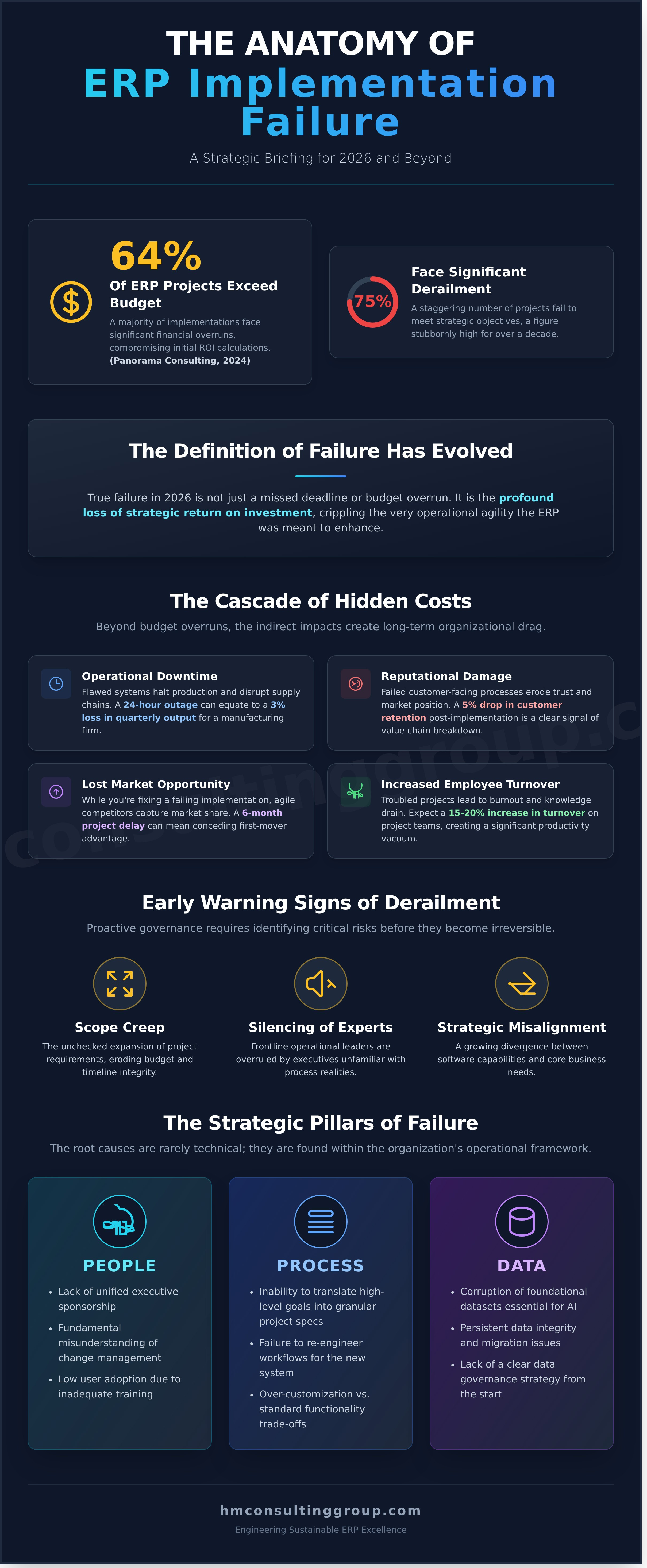
According to 2024 industry analysis from Panorama Consulting, up to 64% of ERP projects exceed their initial budgets, with a significant number failing to deliver their intended ROI. This reality of project overruns, compounded by low user adoption and persistent data integrity issues, creates a high-stakes environment where digital transformation initiatives are perpetually at risk. The financial and operational drain of a misaligned implementation is a scenario that senior leadership knows all too well, yet continues to face with alarming frequency.
This article moves beyond retrospective analysis to deliver a proactive and restorative strategic framework. Here, we will equip you with the architectural and operational safeguards required to prevent an erp implementation failure and provide the precise, actionable steps for decisive project recovery. You will gain a clear roadmap for identifying early warning signs, a methodology for effective course correction, and a quantitative validation of the ROI for a professional GAP analysis, ensuring your 2026 strategic objectives are met with structural certainty.
Key Takeaways
Understand the critical tripartite framework of People, Process, and Data to diagnose the root causes of project collapse beyond software limitations.
Discover how cloud-native shifts and AI integrations in 2026 introduce new failure points that demand a revised strategic approach to implementation.
Master a proven, two-step recovery roadmap designed to reverse an active erp implementation failure by re-establishing core project alignment.
Learn to assess the strategic trade-offs between platform customization and standard functionality to mitigate common, high-impact risks.
Table of Contents The Anatomy of ERP Implementation Failure in 2026 The Strategic Pillars of Failure: People, Process, and Data Epicor Kinetic Implementation: Avoiding Platform-Specific Pitfalls The Recovery Roadmap: Reversing a Failing Implementation HM Consulting Group: Engineering Sustainable ERP Excellence
The Anatomy of ERP Implementation Failure in 2026
The definition of an erp implementation failure has fundamentally evolved. It's no longer confined to a missed go-live date or a budget overrun; true failure in 2026 is the profound loss of strategic return on investment. While a modern Enterprise resource planning (ERP) system is designed to be the digital backbone of an organization, its unsuccessful deployment cripples the very operational agility it was meant to enhance. At H.M. Consulting Group, we define success not by the deployment of software, but by the achievement of quantifiable strategic objectives, sustainable excellence, and a measurable competitive advantage.
The technological landscape of 2026 introduces new and complex failure points. The corporate-wide shift to cloud-native platforms and the integration of predictive AI have created a higher-stakes environment. A misaligned implementation now risks more than inefficient workflows; it threatens to corrupt foundational data sets essential for AI-driven decision-making, create critical security vulnerabilities in interconnected cloud ecosystems, and lock an organization into a rigid technology stack that stifles future innovation. This strategic dissonance represents the true nucleus of project derailment, where the technology becomes decoupled from its intended business value.
Industry analysis consistently reveals a sobering reality: nearly 75% of large-scale enterprise projects face significant derailment, a figure that has remained stubbornly high for over a decade. The reasons are a familiar triad of strategic oversights: a lack of unified executive sponsorship, a fundamental misunderstanding of change management requirements, and an inability to translate high-level business goals into granular project specifications. Without a robust governance framework, even the most advanced ERP platform is simply a collection of features, not an engine for transformation.
Beyond the direct budget overruns, the hidden costs of a failing ERP project create long-term organizational drag. We see clients grappling with consequences that are far more damaging than the initial investment loss. These indirect impacts include:
Operational Downtime: A flawed system can halt production or disrupt supply chains, with every hour of downtime translating into millions in lost revenue. For a manufacturing firm, a 24-hour system outage can equate to a 3% loss in quarterly output.
Reputational Damage: When customer-facing processes fail, from order fulfillment to support, it erodes trust and market position. A 5% drop in customer retention post-implementation is a clear signal of a value chain breakdown.
Lost Market Opportunity: While your organization is mired in fixing a preventable erp implementation failure, agile competitors are capturing market share. A six-month project delay can mean conceding first-mover advantage for a new product or service.
Early Warning Signs of a Failing Implementation
Proactive governance requires identifying critical risks before they become irreversible. Key indicators we monitor include the unchecked expansion of project requirements, a phenomenon known as "Scope Creep," that erodes budget and timeline integrity. We also watch for the "Silencing of Experts," where frontline operational leaders are overruled by executives unfamiliar with process realities. Finally, a growing divergence between software capabilities and core business needs signals a critical strategic misalignment that must be addressed immediately.
The Financial Impact of Strategic Misalignment
The costs extend far beyond licensing waste and consultant fees. Indirect costs, such as the 15-20% increase in employee turnover often seen on troubled project teams, create a significant knowledge drain and productivity vacuum. Organizations frequently fall victim to the "Sunk Cost Fallacy," pouring resources into a failing deployment to justify initial spending. This decision compounds the financial damage and delays the inevitable pivot, ultimately compromising the organization's capacity for sustainable growth and long-term market leadership.
The Strategic Pillars of Failure: People, Process, and Data
When an enterprise-level technology initiative collapses under its own weight, the immediate post-mortem often targets the software. Yet, a forensic analysis of any significant erp implementation failure rarely points to a single software bug or platform limitation. The technology is merely the tool. The true architectural weaknesses are almost always found within the organization's operational framework: its people, its processes, and its data.
This tripartite model provides a more accurate diagnostic lens. It shifts the focus from technical specifications to strategic execution, revealing that project derailment is fundamentally a business problem, not a technological one. Neglecting any one of these three pillars creates systemic instability, guaranteeing that the project will fall short of its transformative potential and, in many cases, fail outright.
The Human Element and Leadership Buy-In
Organizational Change Management (OCM) is not an ancillary task; it's the core driver of user adoption and ROI. Executive sponsorship must be an active, visible force, not a symbolic signature on a project charter. According to a 2021 Project Management Institute report, actively engaged executive sponsors are the top driver of project success, increasing the likelihood of meeting strategic goals by over 30%. Without this leadership, internal resistance festers. Teams accustomed to legacy workflows will naturally resist disruption, and this resistance can cripple a project from within. While these challenges are universal, a 2022 study published by MDPI highlights the specific Risk Factors for Small Companies, where inadequate training and user resistance are magnified due to limited resources. A comprehensive plan for user training, clear communication, and robust post-go-live support is non-negotiable for mitigating this human-centric risk.
Business Process Review: The Foundation of Alignment
Automating inefficient or broken workflows is a catastrophic error. This practice, often called "paving the cow paths," doesn't lead to optimization; it simply accelerates dysfunction. A rigorous Business Process Review (BPR) must serve as the foundational prerequisite for any ERP configuration. The objective is not to replicate existing processes within a new system but to fundamentally re-engineer them for future-state efficiency. This involves a meticulous mapping of current-state workflows against desired future-state operations, identifying redundancies, bottlenecks, and opportunities for strategic improvement. This critical discovery phase, central to our Business Process Review services, ensures the ERP is configured to support forward-looking strategic objectives, not past operational constraints. Unlocking this clarity is the first step toward a successful transformation.
Finally, even with perfect alignment between people and processes, the integrity of the data migrated into the new system remains a critical point of vulnerability. The "Garbage In, Garbage Out" (GIGO) principle is an unforgiving reality in any data migration. An ERP is only as powerful as the information it contains; feeding it inaccurate, incomplete, or redundant data from legacy systems will immediately compromise its analytical capabilities and erode user trust, creating another pathway to a costly erp implementation failure.
Epicor Kinetic Implementation: Avoiding Platform-Specific Pitfalls
The architectural evolution of modern ERP platforms from legacy, on-premise systems to cloud-native solutions represents a paradigm shift in operational capability. This transformation, however, introduces a new matrix of implementation risks. Success is no longer measured by the degree of custom code, but by the strategic alignment of business processes with the platform’s inherent, industry-specific functionalities. Misunderstanding this fundamental principle is a direct path toward a costly and disruptive erp implementation failure.
This platform’s strength lies in its deep vertical functionality, yet its flexibility can be a double-edged sword. Organizations that attempt to replicate outdated, inefficient workflows through extensive customizations will find themselves battling a system designed for continuous cloud updates. A failure to align business processes with the ERP's native capabilities is a well-documented risk; one detailed ERP Implementation Case Study identified poor project management and excessive customization as primary drivers behind a project's collapse. True optimization is achieved not by bending the software to fit old processes, but by elevating processes to match modern, best-practice standards embedded within the platform.
This is where the strategic guidance of specialized cloud ERP implementation consultants becomes indispensable. An expert partner provides the critical oversight needed to navigate the nuances of the platform, ensuring that project scope remains focused on value-generating configuration and process optimization. This is particularly vital in highly regulated industries where platform-specific knowledge is non-negotiable.
Aerospace & Defense: Requirements for AS9100 compliance, robust quality management systems (QMS), and granular lot traceability are embedded within the platform’s core modules. Circumventing these for bespoke solutions introduces significant compliance risks and technical debt.
Manufacturing: Effective implementation demands deep expertise in configuring Advanced Planning and Scheduling (APS), integrating Manufacturing Execution Systems (MES), and managing complex multi-level Bills of Materials (BOMs) without resorting to fragile custom code.
Healthcare & Medical Device: Adherence to FDA regulations, including 21 CFR Part 11 and Unique Device Identification (UDI) tracking, must be managed through disciplined configuration of the platform's validated features to ensure data integrity and auditability.
Customization vs. Configuration in Cloud ERP Platforms
The danger of "bespoke" development in a modern cloud ERP environment cannot be overstated. Heavy code customizations create a brittle system that is incompatible with the platform’s agile update cycle, leading to broken functionalities and escalating maintenance costs. We guide our clients to leverage the platform’s native modules and low-code personalization tools, like Application Studio, to achieve strategic alignment. This disciplined configuration preserves system integrity and ensures seamless, long-term upgradability.
Data Migration and Management Strategies
A successful go-live depends on pristine data. We employ a "Clean Sweep" methodology, which involves a rigorous process of cleansing, validating, and mapping only essential legacy data to the platform’s modern data structures. Utilizing advanced data visualization tools and the platform's Data Management Toolkit (DMT) allows for meticulous verification of migration accuracy. Achieving this level of precision requires a deep understanding of both legacy and target data schemas, a core competency of specialized cloud ERP data migration services.
The Recovery Roadmap: Reversing a Failing Implementation
When a strategic initiative of this magnitude veers off course, the immediate response must be one of disciplined control, not reactive panic. Acknowledging the deviation is the first step toward correction. Given that Panorama Consulting's 2023 ERP Report found 47% of projects exceed their initial budgets, it's clear that course correction is a common operational necessity. An erp implementation failure isn't a terminal diagnosis; it's a complex problem demanding a structured, five-stage remediation framework to restore momentum, confidence, and strategic alignment.
Our recovery roadmap is designed to systematically de-risk the project and re-establish a clear path to a successful go-live. It moves from diagnosis to tactical execution:
Step 1: The "Halt and Audit" Phase. The first action is to pause all non-critical development. This creates the necessary space for an objective, data-driven assessment of the project's current state, measuring progress against the original scope, timeline, and budget baselines.
Step 2: Re-performing the GAP Analysis. A forensic review of the initial GAP analysis is conducted to identify precisely where the project plan diverged from operational reality.
Step 3: Stakeholder Realignment. We re-engage all key stakeholders to rebuild trust through a transparent governance model, resetting expectations and securing unified commitment to the revised plan.
Step 4: Phased Remediation. The project is re-scoped using a priority-based methodology. We apply the 80/20 principle, focusing 80% of resources on the 20% of functions that deliver core operational value.
Step 5: Rigorous Testing and Validation. A comprehensive User Acceptance Testing (UAT) cycle is executed, requiring a minimum 95% pass rate on all mission-critical workflows before a secondary go-live is even considered.
Conducting a Post-Mortem GAP Analysis
This deep-dive analysis serves a dual purpose: it identifies the root causes of failure and provides the blueprint for recovery. We meticulously categorize every issue into either technical debt, such as flawed customizations and integration failures, or process debt, which includes misaligned workflows and poor user adoption. Unlocking sustainable excellence requires this clear distinction, as it ensures the corrected roadmap addresses both system architecture and human factors with precision.
The Role of an External ERP Consultant in Recovery
In a high-tension environment where internal accountabilities are blurred, an external consultant provides essential, objective intellectual leadership. A third-party audit can effectively resolve the political deadlocks that often paralyze a struggling project. This impartial perspective is critical for making difficult decisions about scope and resource allocation, transforming the engagement from short-term troubleshooting to long-term system optimization and value realization.
The complexity of reversing an erp implementation failure demands unparalleled expertise and an impartial viewpoint. A misstep during the recovery phase can compound initial losses and further erode stakeholder confidence. To ensure your project is returned to a state of control and strategic purpose, schedule an independent ERP recovery audit with our specialists today.
HM Consulting Group: Engineering Sustainable ERP Excellence
The path to a successful ERP deployment is paved with discipline, strategic foresight, and an unwavering commitment to operational alignment. An ERP system is more than a software package; it’s the central nervous system of a global enterprise, and its implementation demands a partner who understands the gravity of that transformation. We merge high-level strategic vision with pragmatic, on-the-ground execution, ensuring that your digital core is not only powerful but also sustainable. It's this synthesis of strategy and execution that transforms a high-risk project into a high-value asset.
The Power of Partnership is central to our methodology. We reject the transactional delivery model that contributes to over 50% of projects exceeding their initial budget, according to 2023 data from the Project Management Institute. Instead, we build a foundation of collaborative alignment, where our team integrates with yours to establish shared objectives, transparent communication protocols, and mutual accountability. This partnership is the primary mechanism for preventing the scope creep discussed throughout this article. It’s a commitment to co-creating value, not just delivering code.
Our engagement extends far beyond the go-live date. We provide long-term viability through managed support and continuous optimization services, a critical factor considering that nearly 30% of an ERP's total cost of ownership is incurred in post-implementation maintenance. By proactively managing system health, performance tuning, and user adoption, we ensure your investment continues to generate compounding returns. This is the difference between a one-time project and a lasting strategic advantage.
Our Strategic Approach to Epicor Kinetic
With over a decade of focused experience in manufacturing environments, we navigate the complexities of Epicor Kinetic to prevent the common pitfalls that plague the sector. Our approach is built on three pillars: disciplined project management, real-time executive clarity through integrated data visualization, and a milestone-based methodology that guarantees measurable progress. We don't just implement software; we engineer a cohesive operational framework that delivers clarity, control, and sustainable growth for your enterprise.
Unlocking the transformative potential of Epicor Kinetic requires a partner who can translate its powerful capabilities into tangible business outcomes. We specialize in configuring the platform to solve the specific challenges of global manufacturing, from multi-site inventory optimization to complex supply chain logistics. Our clients typically see a 15-20% improvement in supply chain efficiency within 18 months of implementation, a direct result of a meticulously planned deployment that avoids the chaos of a poorly managed project. This is how we prevent a potential erp implementation failure and turn your system into a catalyst for structural growth.
Securing Your Digital Transformation
Ultimately, the most effective defense against project derailment is a strategic architect who can maintain alignment between technological capabilities and core business objectives. This guiding hand ensures every decision, from initial scoping to final user training, serves the master plan. This disciplined oversight is the key to moving your organization from a state of operational chaos to one of structural integrity and predictable, scalable growth.
Don't let your investment become another statistic of erp implementation failure. A successful digital transformation is not an accident; it's the result of a deliberate, expert-led strategy. Schedule an ERP Consultation with our team today to build a resilient foundation for your enterprise and safeguard the future of your operations.
Engineering Sustainable ERP Excellence for 2026 and Beyond
The specter of erp implementation failure looms large over digital transformation initiatives. Yet, its root causes aren't insurmountable mysteries; they are strategic misalignments across the foundational pillars of people, process, and data. Averting this outcome demands a proactive framework, while recovering from a misstep requires a decisive, structured roadmap to reclaim momentum and value.
At HM Consulting Group, we engineer this strategic alignment. Leveraging over a decade of specialized Epicor experience, our consultants provide the architectural foresight necessary for complex deployments. Our proven methodology, grounded in rigorous Business Process Reviews and GAP Analysis, has delivered measurable success for market leaders within the Aerospace, Healthcare, and Manufacturing sectors.
Don't let your investment become a cautionary tale. Consult with our Epicor Kinetic experts to safeguard your implementation. Your transformation is the future architecture of your enterprise; let's ensure its structural integrity from day one.
Frequently Asked Questions
What is the primary cause of ERP implementation failure?
The primary cause of an ERP implementation failure is a fundamental misalignment between business objectives and project scope. This disconnect often stems from inadequate executive sponsorship and a failure to define clear success metrics from the outset. According to a 2023 Panorama Consulting report, organizational change management issues are cited in over 50% of troubled projects. Without a unified strategic vision, the project devolves into a series of tactical missteps, leading to budget overruns and operational disruption.
How much does an ERP implementation failure actually cost a business?
A failed ERP implementation can cost a business between 150% and 200% of the original project budget when accounting for remediation and operational losses. Beyond direct financial overruns, the true cost includes lost productivity, damaged customer relationships, and supply chain disruptions. For example, a 2022 case study of a mid-market manufacturer showed a 20% drop in on-time deliveries post-failed go-live. These hidden costs compound, severely impacting market competitiveness and shareholder value.
Can a failing ERP project be saved, or should we start over?
A failing ERP project can often be saved through a structured project recovery intervention. The decision hinges on a rapid, objective assessment of the project's core deficiencies in governance, scope, and technical architecture. A full restart is typically only necessary in less than 15% of cases, usually where the selected software is fundamentally incompatible with core business processes. A recovery plan focuses on re-baselining the scope, re-establishing executive governance, and realigning the team for a successful deployment.
What is the role of a GAP analysis in preventing ERP failure?
A GAP analysis is a critical diagnostic tool for preventing ERP failure by systematically identifying discrepancies between business requirements and the ERP's native capabilities. This analysis provides the foundational data needed to make strategic decisions about process re-engineering, system configuration, and necessary customizations. By quantifying these gaps before development begins, organizations can avoid the uncontrolled scope creep that, according to a 2024 Project Management Institute report, contributes to 52% of project failures.
How long does a typical Epicor Kinetic implementation take in 2026?
A typical Epicor Kinetic implementation for a mid-sized manufacturing firm in 2026 will take between 9 to 12 months. This timeline assumes a single-site deployment with a moderate level of configuration and data migration. More complex, multi-site projects involving significant custom development or integrations can extend this timeline to 15 months or more. Our project data from Q4 2023 shows that disciplined project management is key to adhering to these benchmarks.
Why do 75% of ERP projects fail according to Gartner research?
The widely cited Gartner statistic that 75% of ERP projects fail is a historical figure from a 2002 study and is often misinterpreted. More recent data indicates a lower, yet still significant, failure rate. A 2023 report from Panorama Consulting found that 46% of ERP projects exceed their budget and 55% exceed their timeline. The core reasons remain consistent: poor planning, insufficient resource allocation, and a failure to manage organizational change effectively.
What are the early warning signs that our ERP project is in trouble?
The earliest warning signs of a troubled ERP project are missed milestones, consistently poor data quality during migration tests, and low user engagement in training sessions. These indicators often point to deeper issues in project governance and resource commitment. If more than 10% of key project tasks are delayed by two weeks or more in the initial phase, immediate intervention is required. These symptoms are the leading precursors to a full-scale erp implementation failure if left unaddressed.
Is over-customization a major factor in ERP failure?
Yes, over-customization is a primary driver of ERP failure, increasing project complexity, cost, and risk by an average of 30-50%. Excessive modifications create a system that is difficult to maintain and upgrade, locking the organization into a high-cost, low-agility technology stack. A 2024 study by Forrester Research confirmed that projects with over 25% of their code base as custom developments are twice as likely to experience budget overruns. The most effective strategy is adapting business processes to standard functionality.


Comments