

The Strategic ERP Project Plan: A Comprehensive Implementation Framework for 2026
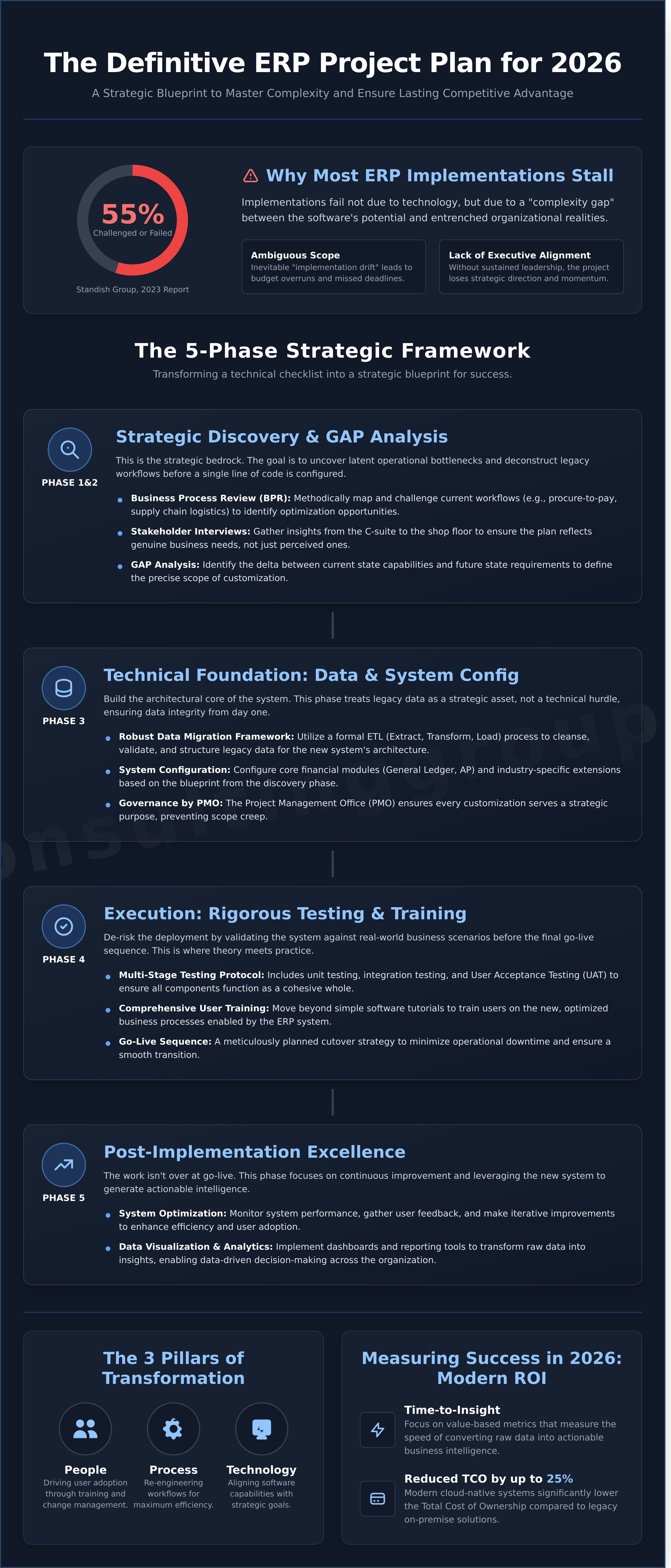
According to a 2023 report from the Standish Group, over 55% of ERP implementations are challenged or fail outright, exceeding their budgets and timelines. This figure validates a reality many leaders know intimately: the immense potential of enterprise resource planning is too often undermined by flawed execution. The consequences are severe, manifesting as compromised data integrity, significant operational downtime, and deep-seated organizational resistance to necessary process changes.
Unlocking the full transformative power of your ERP investment requires a fundamentally different approach; it demands a strategic blueprint engineered for clarity, control, and sustainable performance. This article provides that expert-led, structured roadmap, designed to master complexity and deliver a system that yields actionable intelligence. We will detail the definitive erp project plan for 2026, a phased framework built to ensure your technological transformation becomes a lasting competitive advantage.
Key Takeaways
Understand how to transform your erp project plan from a simple technical checklist into a strategic blueprint that aligns software capabilities with operational reality.
Master the methodologies of Strategic Discovery and Business Process Review to identify latent operational bottlenecks and deconstruct legacy workflows before implementation begins.
Develop a robust data migration framework that treats legacy data as a strategic asset, leveraging the ETL process to ensure architectural integrity.
Learn to de-risk your deployment through a multi-stage testing protocol that validates the system against real-world business scenarios before the final go-live sequence.
Table of Contents What is an ERP Project Plan and Why Do 75% of Initiatives Initially Stall? Phase 1 & 2: Strategic Discovery, Business Process Review, and GAP Analysis Constructing the Technical Foundation: Data Migration and System Configuration Execution Strategy: Rigorous Testing, Training, and the Go-Live Sequence Post-Implementation Excellence: System Optimization and Data Visualization
What is an ERP Project Plan and Why Do 75% of Initiatives Initially Stall?
An Enterprise Resource Planning (ERP) implementation is frequently miscategorized as a technology upgrade. This fundamental misunderstanding is the primary reason why, according to a 2021 report from the Standish Group, nearly 75% of large-scale IT projects either fail or significantly exceed their budgets. The challenge isn't the software; it's the profound organizational transformation the software demands. An effective erp project plan is therefore not a simple project schedule with timelines and tasks. It is a multi-layered strategic blueprint designed to re-engineer core business functions, align disparate departments, and institutionalize data-driven decision-making.
The majority of these initiatives stall within a "complexity gap" a chasm between the theoretical capabilities of a modern Enterprise resource planning (ERP) system and the entrenched operational realities of an organization. This gap is widened by two primary drivers of project failure: ambiguous scope definition and a critical lack of sustained executive alignment. Without a rigorously defined strategic architecture to guide the initiative, implementation drift becomes inevitable, leading to budget overruns, missed deadlines, and a final product that fails to deliver its promised value. This architecture is the essential antidote, providing the structural integrity required to translate high-level vision into tactical execution.
The Anatomy of a Modern ERP Framework
A successful framework is built upon a clear distinction between core financial modules, such as general ledger and accounts payable, and the industry-specific extensions required for competitive differentiation in sectors like manufacturing or logistics. The Project Management Office (PMO) provides the structural discipline necessary to govern this complex ecosystem, ensuring that every customization serves a strategic purpose. Ultimately, sustainable transformation rests on a tripartite approach, one that harmonizes the critical pillars of People, Process, and Technology.
Setting Realistic ROI Expectations for 2026
As we advance toward 2026, the metrics for success have evolved beyond simple cost-cutting. Organizations must now focus on value-based metrics like "Time-to-Insight," which measures the speed at which raw data can be converted into actionable business intelligence. Modern cloud-native systems are engineered to accelerate this process while reducing long-term Total Cost of Ownership (TCO) by up to 25% compared to legacy on-premise solutions. ERP ROI is the intersection of operational efficiency and data-driven agility.
Therefore, a comprehensive erp project plan must function as more than a guide; it must serve as the constitutional document for the enterprise's operational future. It codifies the objectives, aligns the stakeholders, and provides the governance framework necessary to navigate the complexities of systemic change. This strategic discipline is the definitive factor separating a stalled initiative from a truly transformative deployment.
Phase 1 & 2: Strategic Discovery, Business Process Review, and GAP Analysis
The initial phases of an ERP implementation are not administrative preliminaries; they are the strategic bedrock upon which organizational transformation is built. Success hinges on a disciplined approach to discovery, uncovering the latent operational bottlenecks that legacy systems and entrenched habits often conceal. This requires a deep, methodical investigation that moves beyond surface-level assumptions to capture the granular reality of daily operations. The insights gathered from stakeholder interviews, which must encompass perspectives from the C-suite to the shop floor, are foundational to creating a formalized ERP project plan that reflects genuine business needs rather than perceived ones. It's this rigorous diligence that separates a tactical software installation from a true strategic realignment.
The Power of the Business Process Review
Simply paving over old, inefficient processes with new software is a recipe for expensive failure. A Business Process Review (BPR) is the methodical deconstruction of current workflows, designed to challenge the "way it has always been done." In complex sectors like manufacturing, this involves mapping intricate procure-to-pay cycles, supply chain logistics, and quality control checkpoints. In healthcare, it means dissecting patient intake-to-discharge pathways to identify friction points. At H.M. Consulting Group, we leverage this diagnostic phase to identify critical optimization opportunities, ensuring the new ERP system enables superior processes, not just automates flawed ones. Our analysis consistently shows that a well-executed BPR can unlock efficiency gains of 15-20% before the system even goes live.
Conducting a Rigorous GAP Analysis
With a clear map of current ("As-Is") processes, the next critical step is the GAP analysis, which meticulously identifies the delta between your present state and future ("To-Be") requirements. The objective is to translate broad business goals into specific system functionalities. To bring structure to this process, we categorize all identified gaps into three distinct buckets, providing clarity for the subsequent technical design and configuration stages of the erp project plan.
Functional Gaps: Discrepancies where the out-of-the-box ERP software doesn't support a required business process, such as a unique commission calculation or a specialized inventory valuation method.
Technical Gaps: Deficiencies related to system architecture, including necessary integrations with legacy machinery, third-party logistics platforms, or specific data security protocols.
Operational Gaps: Issues concerning user skills, training needs, or changes in roles and responsibilities required to operate within the new system environment.
Prioritizing these requirements is essential. We employ the MoSCoW method (Must-have, Should-have, Could-have, Won’t-have) to create a clear hierarchy. This framework forces decisive action, preventing scope creep and ensuring that development resources are focused squarely on mission-critical capabilities. The resulting analysis directly informs the final system configuration, customization scope, and data migration strategy, thereby ensuring the technology is precisely aligned with your strategic objectives.
Constructing the Technical Foundation: Data Migration and System Configuration
Once the strategic blueprint is finalized, the implementation team transitions from planning to architectural execution. This phase is where the conceptual framework of an erp project plan materializes into a functional, data-driven system. Success at this stage depends on treating corporate data not as a technical burden to be moved, but as a primary strategic asset that will fuel future growth and operational intelligence. The integrity of this foundation, built through meticulous data migration and precise system configuration, dictates the long-term value and ROI of the entire ERP initiative.
The Framework for Data Migration Excellence
The axiom of "garbage in, garbage out" has never been more relevant. A disciplined approach to data migration begins with rigorous data cleansing long before the first record is transferred. According to Gartner, poor data quality costs organizations an average of $12.9 million annually. The risks of migrating "dirty data" from legacy systems are threefold: it compromises the accuracy of financial and operational reporting, degrades system performance through processing inefficiencies, and fundamentally erodes user trust in the new platform. Our methodology for the Extract, Transform, Load (ETL) process mandates strict validation protocols to ensure absolute data integrity post-migration.
Record Count Validation: A systematic reconciliation of record counts between the source and target systems to guarantee no data is lost during transfer.
Checksum Verification: The application of checksum algorithms to critical data fields, such as financial figures and inventory levels, to detect any corruption.
Targeted User Acceptance Testing (UAT): Business process owners validate migrated data by running sample reports and executing core transactions within a test environment.
Tailoring Epicor Kinetic to Your Industry
System configuration is the critical process of aligning Epicor Kinetic's powerful modules with the specific operational realities identified during the GAP analysis. A core strategic decision lies in balancing configuration with customization. Configuration leverages the system’s native, built-in settings to meet business requirements, ensuring streamlined future upgrades and lower total cost of ownership. Customization, which involves altering the source code, should be reserved for unique business differentiators that cannot be addressed through standard functionality. Over-customization introduces significant technical debt, complicating maintenance and impeding agility.
For an aerospace and defense contractor, this means configuring the Quality Management and Advanced Material Management modules to enforce the stringent traceability and compliance mandates of AS9100. For a discrete manufacturer, it involves tailoring the Advanced MES module to deploy real-time Statistical Process Control (SPC) on the shop floor, targeting a 15-20% reduction in defect rates. Expert Data Management & Migration services are indispensable here, providing the strategic oversight to optimize the system for sustainable excellence while actively mitigating technical debt.
Finally, a robust security architecture is integrated directly into the configuration. We implement a Role-Based Access Control (RBAC) framework to enforce the principle of least privilege, ensuring users can only access the data and functions essential to their roles. This structural control is reinforced with enterprise-grade encryption standards, including AES-256 for data at rest and TLS 1.3 for data in transit, safeguarding sensitive information and securing the digital core of the enterprise.
Execution Strategy: Rigorous Testing, Training, and the Go-Live Sequence
The transition from system configuration to operational execution marks the most critical phase of digital transformation. A meticulously structured execution strategy is not merely a procedural step; it's the mechanism that validates every preceding decision and ensures the system’s structural integrity under real-world pressures. Success is predicated on a tripartite foundation: exhaustive testing, comprehensive user enablement, and a disciplined go-live sequence. This phase transforms theoretical value into tangible operational performance, converting the strategic vision of your erp project plan into a functional reality.
Testing Methodologies for Complex Environments
System validation extends far beyond simple functional checks. While functional testing verifies that individual modules and custom configurations perform as designed, integrated system testing confirms that complex, cross-departmental workflows operate seamlessly. We orchestrate a series of Conference Room Pilots (CRPs) where core project team members and end-users execute scripted, day-in-the-life scenarios. This process moves from isolated transactions to a full simulation of business operations, identifying process gaps and data inconsistencies before they impact the enterprise. Common red flags that demand a go-live reassessment include a data validation failure rate above 1%, any unresolved critical defects in core financial or operational workflows, or a user confidence score below 85% in the final UAT cycle.
Unlocking Human Potential Through Training
Technological adoption is fundamentally a human endeavor. Overcoming user resistance requires a strategic approach to change management that addresses the psychology of disruption by reframing the ERP as a tool for empowerment, not replacement. We champion a "Train-the-Trainer" model, a powerful methodology for cultivating internal expertise and fostering long-term self-sufficiency. This approach creates a network of departmental super-users who become go-to resources for their peers, drastically accelerating adoption. This initial enablement is sustained through continuous development platforms like the Epicor Learning Center, which provides ongoing, role-specific education to ensure your workforce masters the system’s full capabilities.
The final countdown to deployment is the culmination of the entire erp project plan. It demands absolute precision. The final 72-hour checklist is a non-negotiable sequence of events:
T-72 Hours: System lockdown and initiation of the final data migration from legacy systems.
T-48 Hours: Completion of data migration and execution of a full validation script, reconciling key financial and inventory balances to within a 0.1% tolerance.
T-24 Hours: Final technical cutover, system integration checks, and formal go/no-go decision from the steering committee.
Immediately following a successful launch, we initiate a 30-day Hypercare period. This intensive, on-site support structure provides immediate technical and functional assistance, ensuring operational stability and reinforcing user confidence as the organization transitions to the new platform. Ensure your execution strategy is architected for success. Partner with us to validate and deploy your ERP with precision.
Post-Implementation Excellence: System Optimization and Data Visualization
The successful deployment of an ERP system marks not an end, but a critical transition. Go-live is the beginning of the value-realization phase, where the system’s true potential is unlocked through a disciplined cycle of optimization, analysis, and strategic alignment. A forward-thinking erp project plan dedicates significant resources to this post-implementation reality, transforming the initial investment into a dynamic engine for sustainable growth. This final stage is where operational execution converges with strategic vision, creating a continuous improvement loop that ensures the technology evolves in lockstep with your business objectives.
This commitment to sustained performance is built on three core pillars: proactive system refinement, intelligent data interpretation, and dedicated long-term support. Without this framework, even the most robust ERP implementation risks becoming a static, depreciating asset. We ensure it remains a competitive advantage.
The Power of Data Visualization and Reporting
A modern ERP is fundamentally a centralized data repository; its strategic power is only activated when that data is transformed into actionable intelligence. Advanced reporting and visualization tools convert millions of raw data points into clear, executive-level dashboards that illuminate trends, expose inefficiencies, and guide high-stakes decisions. For manufacturing clients, the integration of Statistical Process Control (SPC) with ERP production data has been shown to reduce defect rates by up to 22% within 18 months by identifying process variations in real-time. Achieving this level of C-suite clarity requires specialized expertise, which is the core focus of our Data Visualization & Reporting services.
Sustainable Excellence Through Managed Support
The post-implementation landscape is dynamic, with software updates, evolving security threats, and shifting business processes requiring constant vigilance. A managed support retainer isn't an operational cost; it's a strategic investment in system longevity and peak performance. Industry analysis from Nucleus Research confirms that organizations with formal post-implementation support contracts realize a 30% higher long-term ROI from their ERP investment. Regular "System Health Checks" are integral to this process, as they proactively address potential issues before they impact operations. These scheduled audits typically include:
Performance Monitoring: Analyzing database query speeds and transaction processing times to prevent the 5-10% annual performance degradation common in unmanaged systems.
Workflow Optimization: Identifying and refining inefficient user processes or workflows that have emerged post-launch.
Security and Compliance Audits: Ensuring all necessary patches are applied and the system remains compliant with industry standards like SOC 2 or HIPAA.
Your initial erp project plan must therefore account for this crucial, ongoing partnership. This is where we position ourselves as your long-term strategic anchor. H.M. Consulting Group provides the structural foundation for your ERP's continued success, ensuring the system that drives your business today is optimized to meet the challenges of tomorrow.
Unlocking Sustainable Growth Through Strategic ERP Execution
The data is clear: 75% of ERP initiatives falter without a robust strategic framework. The difference between stagnation and transformation lies not in the technology alone, but in the disciplined execution of a comprehensive erp project plan. Success is anchored in two critical phases: the initial strategic discovery that aligns technology with business objectives and the continuous post-implementation optimization that ensures long-term value realization. It's a commitment to a full lifecycle, not just a launch date.
Navigating this complexity demands a partner with proven, specialized expertise. At H.M. Consulting Group, we bring over a decade of dedicated Epicor Kinetic experience to enterprises in the Aerospace, Healthcare, and Manufacturing sectors. Our approach integrates strategic planning with comprehensive managed support, creating a seamless transition from implementation to sustained operational excellence.
Don't let your transformation become a statistic. Unlock the Power of Strategic ERP Transformation with H.M. Consulting Group and build the operational foundation for your 2026 objectives and beyond.
Frequently Asked Questions
What are the most common risks in an ERP project plan?
The three most prominent risks are budget overruns, scope creep, and inadequate change management. A 2021 Panorama Consulting report found that 58% of ERP projects exceed their initial budget. These financial risks are often driven by an undefined scope or a failure to secure user adoption. A disciplined project governance structure is essential for mitigating these threats and ensuring the project delivers its intended strategic value through rigorous control and stakeholder alignment.
How long does a typical Epicor Kinetic implementation take?
A typical Epicor Kinetic implementation for a mid-sized organization of 150-250 users takes between six and twelve months. The precise timeline depends on factors like data complexity, the number of modules being deployed, and the extent of required process re-engineering. We find that phased rollouts, which allow for iterative testing and training, often yield a more successful and timely go-live compared to a "big bang" approach, aligning the deployment with operational readiness.
What is the difference between ERP configuration and customization?
Configuration uses the ERP's native tools to tailor the system to your processes, whereas customization involves altering the software's source code to create new functionality. While configuration is supported by vendor updates, customization can increase the total cost of ownership by up to 50% over the system's lifecycle due to complex maintenance. We advise clients to exhaust all configuration possibilities before considering code-level customizations to preserve system integrity and control long-term costs.
How do I calculate the ROI of an ERP implementation?
You calculate ROI using the formula: (Net Financial Gain - Project Cost) / Project Cost. Net gain includes quantifiable improvements such as a 10-20% reduction in inventory holding costs or a 15% increase in production efficiency. It's also critical to factor in strategic benefits like enhanced data visibility and improved regulatory compliance. A comprehensive ROI analysis provides the business case necessary for executive sponsorship and justifies the significant capital investment.
Why is GAP analysis critical to the project plan?
A GAP analysis is critical because it systematically identifies the discrepancies between your business requirements and the ERP's standard capabilities. This process is foundational to a successful erp project plan, as it defines the precise scope of necessary configurations and customizations. According to the Project Management Institute, 52% of projects experience scope creep; a thorough GAP analysis directly mitigates this risk by ensuring all functional needs are documented and addressed before development begins.
How can we minimize employee resistance to the new ERP system?
Minimizing resistance requires a structured organizational change management (OCM) program. Projects with excellent OCM are six times more likely to meet objectives, according to Prosci research. We implement a tripartite strategy focused on executive communication, comprehensive user training initiated 60 days before go-live, and the empowerment of departmental "super users." This ensures that your team is not only prepared for the change but also invested in its success.
What role does data migration play in project delays?
Data migration is a primary driver of project delays, contributing to timeline overruns in nearly 40% of ERP implementations, per a 2022 Gartner report. The process of cleansing, validating, and mapping legacy data is frequently underestimated in the initial erp project plan. Establishing a dedicated data governance team early in the project is non-negotiable for ensuring data integrity and preventing bottlenecks that can derail the entire implementation schedule.
Should we choose a cloud-based or on-premise ERP deployment?
The decision between cloud and on-premise deployment hinges on your organization's priorities regarding capital expenditure, IT resources, and scalability. Cloud deployments, now accounting for over 60% of the market, offer lower initial costs and greater agility. In contrast, on-premise solutions provide superior control over data security and customization. We facilitate a detailed TCO analysis to align the deployment model with your firm's long-term strategic and financial objectives.


Comments